online advertising
Showing posts with label Differential Geometry. Show all posts

Friday, March 4, 2016

Differential Geometry of Curves and Surfaces - Chapter 1 Section 3 Exercise 3

Problem:


Note the errata to this problem here. In particular, B should be on the line with OC and that's the half line r.

Solution:

Note that $ \angle OCA $ is a right angle.

$ \frac{CA}{2a} = \sin \theta $
$ \frac{BA}{2a} = \tan \theta $
$ CA^2 + CB^2 = BA^2 $

$ (2a \sin \theta)^2 + CB^2 = (2a \tan \theta)^2 $
$ OP^2 = CB^2 = 4a^2(\tan^2 \theta - \sin^2 \theta) $

With some trigonometry, we get

$ \sec^2 \theta = 1 + \tan^2 \theta = 1 + t^2 $
$ \cos^2 \theta = \frac{1}{\sec^2 \theta} = \frac{1}{1 + t^2} $
$ \sin^2 \theta = 1 - \cos^2 \theta = 1 - \frac{1}{1 + t^2} = \frac{t^2}{1 + t^2} $
$ \tan^2 \theta - \sin^2 \theta = t^2 - \frac{t^2}{1 + t^2} = \frac{t^4 + t^2 - t^2}{1 + t^2} = \frac{t^4}{1 + t^2} $

So we get $ OP = \frac{2at^2}{\sqrt{1 + t^2}} $

$ x = OP \cos \theta = \frac{2at^2}{1 + t^2} $
$ y = OP \sin \theta = \frac{2at^3}{1 + t^2} $

This time around I solved the problem with a good diagram and geometrical insight without using MATLAB.

Part (b) is trivial, when $ t \to \pm \infty $, $ x \to 2a $, $ y \to 0 $,

$ \alpha' = 2a\frac{1}{(1+t^2)^2}((1 + t^2)2t - t^2(2t), (1 + t^2)3t^2 - t^3(2t)) $

So $ \alpha'(t) = (0, 2a) $ as $ t \to \pm \infty $

At this point I am still confused, look like $ \alpha'(t) $ should be $ (0, 2a) $ and not $ (2a, 0) $?

Thursday, February 18, 2016

Differential Geometry of Curves and Surfaces - Chapter 1 Section 3 Exercise 2

Problem:


Solution:

We will skip part (a) because it is basically the same as this previous exercise. The solution is $ (t - \sin t, 1 - \cos t) $

For part (b), we compute the arc length as

$ \begin{eqnarray*} & & \int\limits_{0}^{2\pi}{\left|\alpha'(t)\right|dt} \\ &=& \int\limits_{0}^{2\pi}{\sqrt{\alpha'(t) \cdot \alpha'(t)}dt} \\ &=& \int\limits_{0}^{2\pi}{\sqrt{(1-\cos t)^2 + \sin^2 t}dt} \\ &=& \int\limits_{0}^{2\pi}{\sqrt{1 - 2\cos t + \cos^2 t + \sin^2 t}dt} \\ &=& \int\limits_{0}^{2\pi}{\sqrt{2 - 2\cos t}dt} \\ \end{eqnarray*} $

The rest is really just an integration problem, let $ x = \cos t $, so

$ \begin{eqnarray*} dx &=& -\sin t dt \\ &=& -\sqrt{1 - \cos^2 t} dt \\ &=& -\sqrt{1 - x^2}dt \\ dt &=& \frac{dx}{-\sqrt{1-x^2}} \end{eqnarray*} $

When $ t = 0 $, $ x = \cos 0 = 1 $
When $ t = \pi $, $ x = \cos \pi = 0 $

$ \begin{eqnarray*} & & \int\limits_{0}^{2\pi}{\sqrt{2 - 2\cos t}dt} \\ &=& 2\int\limits_{0}^{\pi}{\sqrt{2 - 2\cos t}dt} \\ &=& 2\int\limits_{1}^{-1}{\sqrt{2 - 2x}\frac{dx}{-\sqrt{1-x^2}}} \\ &=& 2\int\limits_{-1}^{1}{\sqrt{\frac{2 - 2x}{1-x^2}}dx} \\ &=& 2\sqrt{2}\int\limits_{-1}^{1}{\sqrt{\frac{1}{1 + x}}dx} \\ &=& 4\sqrt{2}\sqrt{1+x}|_{-1}^{1} \\ &=& 8 \\ \end{eqnarray*} $

Just as an aside, I used numerical integration and arc length approximation to make sure the answer is correct.

Differential Geometry of Curves and Surfaces - Chapter 1 Section 3 Exercise 1

Problem:


Solution:

The tangent line has direction $ \vec{a} = (3, 4t, 8t^2) $
The given line has parametric form $ (u, 0, u) $ so it's direction $ \vec{b} (1, 0, 1) $

The angle between these two direction is $ \frac{\vec{a} \cdot \vec{b}}{|\vec{a}||\vec{b}|} = \frac{(3 + 8t^2)}{\sqrt{3^2 + (4t)^2 + (8t^2)^2}\sqrt{1^2 + 0^2 + 1^2}} = \frac{(3 + 8t^2)}{\sqrt{9 + 16t^2 + 64t^4}\sqrt{2}} = \frac{(3 + 8t^2)}{\sqrt{(3 + 8t^2)^2}\sqrt{2}} = \frac{1}{\sqrt{2}}$

So the angle is constant.

Wednesday, February 17, 2016

Differential Geometry of Curves and Surfaces - Chapter 1 Section 2 Exercise 5

Problem:


Solution:

$ |\alpha(t)| $ is a constant if and only if $ \alpha(t) \cdot \alpha(t) $ is a constant, so we focus on the latter, as a differentiable function of $ t $. Now it is differentiable and it is constant, then its derivative must be 0.

$ (\alpha(t) \cdot \alpha(t))' = 2 \alpha(t) \cdot \alpha'(t) $ so we know $ |\alpha(t)| $ is a constant if and only if the two vectors $ \alpha(t) $ and $ \alpha'(t) $ are orthogonal.

Differential Geometry of Curves and Surfaces - Chapter 1 Section 2 Exercise 4

Problem:


Solution:

Consider the function $ \alpha(t) \cdot v $, it is a differentiable function of $ t $, now $ (\alpha(t) \cdot v)' = 2\alpha'(t) \cdot v = 0 $ as the vectors are orthogonal. So $ \alpha(t) \cdot v $ is a constant function, and therefore $ \alpha(t) $ is orthogonal to $ v $ for all $ t $.

Differential Geometry of Curves and Surfaces - Chapter 1 Section 2 Exercise 3

Problem:


Solution:

Note that $ \alpha''(t) = 0 \implies \alpha'(t) = (a, b, c) $ is constant independent of t, so $ \alpha(t) = (at + x_0, bt + y_0, ct + z_0) $ is a straight line.

Differential Geometry of Curves and Surfaces - Chapter 1 Section 2 Exercise 2

Problem:


Solution:

The squared distance between $ \alpha(t) $ and the origin is $ \alpha(t) \cdot \alpha(t) $. It is a differentiable function of $ t $ and it reaches minimum at $ t_0 $, so $ (\alpha(t_0) \cdot \alpha(t_0))' = 0 $

Using the product rule, we get $ \alpha'(t_0) \cdot \alpha(t_0) = 0 $, now both vectors are non zero so they must be orthogonal.

Differential Geometry of Curves and Surfaces - Chapter 1 Section 2 Exercise 1

Problem:


Solution:

$ \alpha(t) = (\cos t, -\sin t) $.

Be careful with the clockwise direction.

Monday, February 15, 2016

Differential Geometry and Its Application - Exercise 3.1.10

Problem:


Solution:

A surface is minimal if its mean curvature is 0, so the sum of the eigenvalues is 0. Let the eigenvalues be $ x $ and $ y $ respectively, the Gaussian curvature K is then the product $ xy = x(-x) = -x^2 \le 0 $

Differential Geometry and Its Application - Exercise 3.1.9

Problem:


Solution:

Let's compute the shape operator for the cylinder. First, we parametrize the cylinder as follow:

$ (R \cos u, R \sin u, v) $.

$ x_u = (-R \sin u, R \cos u, 0) $.
$ x_v = (0, 0, 1) $.

The normal vector is $ x_u \times x_v = (R \cos u, R \sin u, 0) $

The unit normal vector is then $ (\cos u, \sin u, 0) $

$ S_{p}(x_u) = -\nabla_{x_u}U = (x_u[\cos u], x_u[\sin u], x_u[0]) = (\frac{\partial \cos u}{\partial u}, \frac{\partial \sin u}{\partial u}, \frac{\partial 0 u}{\partial u}) = (-\sin u, \cos u, 0) $

$ S_{p}(x_v) = -\nabla_{x_v}U = (x_v[\cos u], x_v[\sin u], x_v[0]) = (\frac{\partial \cos u}{\partial v}, \frac{\partial \sin u}{\partial v}, \frac{\partial 0 v}{\partial v}) = (0, 0, 0) $

Now, if we write a vector on the tangent plane using $ x_u $ and $ x_v $ as basis, then we know the shape operator can be written as a matrix $ \left(\begin{array}{cc}A & B\\C & D\end{array}\right) $

$ S_{p}(x_u) = \frac{1}{R}x_u \implies \left(\begin{array}{cc}A & B\\C & D\end{array}\right)\left(\begin{array}{c}1 \\ 0\end{array}\right) = \left(\begin{array}{c}\frac{1}{R} \\ 0\end{array}\right) $

$ S_{p}(x_v) = 0 \implies \left(\begin{array}{cc}A & B\\C & D\end{array}\right)\left(\begin{array}{c}0 \\ 1\end{array}\right) = \left(\begin{array}{c}0 \\ 0\end{array}\right) $

So the overall shape operator matrix is simply $ \left(\begin{array}{cc}\frac{1}{R} & 0\\0 & 0\end{array}\right) $, and therefore its eigenvalues are $ \frac{1}{R} $ and $ 0 $, so the mean curvature is $ \frac{1}{2R} $ and the Gaussian curvature is $ 0 $.

That is why the surface is flat, but not minimal.

Friday, February 12, 2016

Differential Geometry and Its Application - Exercise 2.4.4

Problem:


Solution:

By definition, we have this
$ \nabla_{u_1} U = -S_{p}(u_1) = - k_1 u_1 $

Suppose $ \alpha' = u_1 $, then $ U' = \nabla_{\alpha'} U = \nabla_{u_1} U = -S_{p}(u_1) = - k_1 u_1  =  - k_1 \alpha' $.

Suppose $ \alpha' \ne u_1 $ and $ \alpha' \ne u_2 $ , then $ U' = \nabla_{\alpha'} U = -S_{p}(\alpha') \ne c \alpha' $ for constant $ c $ as $ \alpha' $ is not an eigenvector.

For the second part, as the angle between the surface and the plane is constant, we get

$ U_M \cdot U_P = c $.

So we can take the directional derivative for this one.

$ 0 = \alpha'[U_M \cdot U_P] = \alpha'[U_M] \cdot U_P + \alpha'[U_P] \cdot U_M $

$ -\alpha'[U_M] \cdot U_P = \alpha'[U_P] \cdot U_M $

$ S_p(\alpha') \cdot U_P =0 $

We know $ S_p(\alpha') $ is on the tangent plane. We now also know it is on $ P $, so it has to be $ k\alpha' $. So $ \alpha' $ is an eigenvector of the Weingarten map, and the curve is a line of curvature.

Thursday, January 28, 2016

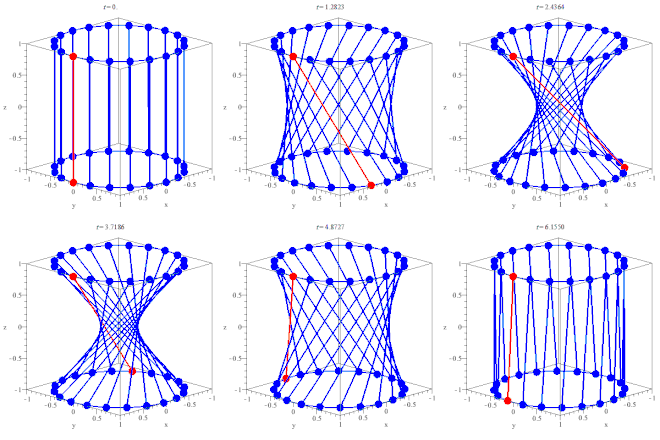
Differential Geometry and Its Application - Exercise 2.1.22

Problem:


Solution:

Disclaimer, I thought about the solution with the hint from wikipedia, in particular, this spinning model. But not the hint text in the problem.

There I started to think, maybe the lines are just joining points on the circle with a phase shift. So I tried:

$ (0, 0, -1) \to (\cos \theta, \sin \theta, 1) $, the mid point is $ \frac{1}{2}(\cos \theta, \sin\theta, 0) $, so that is indeed on a circle in the $ z = 0 $ plane.

With that in mind, now I generalize, for the general hyperboloid, when $ z = \pm c $, it is a ellipse with major radius $ \sqrt{2} a $ and minor radius $ \sqrt{2} b $.

Consider the 'phase shift' lines:

$ \sqrt{2}((a \cos u, b \sin u, -c) + v(a \cos (u + s), b \sin (u + s), c)) $

Our goal is to find the unknown $ s $, the phase shift required, to fit the formula. To do that, we just check if all these points is in fact on the hyperboloid.

$ \begin{eqnarray*} & & \frac{x^2}{a^2} + \frac{y^2}{b^2} - \frac{z^2}{c^2} \\ &=& \frac{(\sqrt{2}(a\cos u + va\cos(u + s)))^2}{a^2} + \frac{\sqrt{2}(b\sin u + vb\sin(u + s)))^2}{b^2} - \frac{(\sqrt{2}((-c) + vc)^2}{c^2} \\ &=& 2(\cos u + v\cos(u + s))^2 + 2(\sin u + v\sin(u + s))^2 - 2(v - 1)^2 \\ &=& 2\cos^2 u + 4v \cos u \cos(u + s) + 2v^2\cos^2(u + s) + 2\sin^2 u + 4v \sin u \sin(u + s) + 2v^2\sin^2(u + s) - 2v^2 + 4v - 2 \\ &=& 2\cos^2 u + 2\sin^2 u + 2v^2\cos^2(u + s) + 2v^2\sin^2(u + s) + 4v \cos u \cos(u + s) + 4v \sin u \sin(u + s) - 2v^2 + 4v - 2 \\ &=& 2\ + 2v^2 + 4v \cos (s) - 2v^2 + 4v - 2 \\ &=& 4v \cos (s) + 4v \\ \end{eqnarray*} $

At this point it should be obvious that $ s = \pm \pi $, that correspond to the two ruling patch for the surface, and the surface is doubly ruled.

Now looking at the hint in the text, I think I can simplify this by making the ellipse at $ z = 0 $ the directix instead, to do so, we just move $ v $ by 1 as follow:

$ \sqrt{2}((a \cos u, b \sin u, -c) + 1(a \cos (u + s), b \sin (u + s), c) + v(a \cos (u + s), b \sin (u + s), c)) $

$ \sqrt{2}((a (\cos u + \cos (u + s)), b (\sin u +\sin (u + s)),  0) + v(a \cos (u + s), b \sin (u + s), c)) $

Now we can use the sum to product formula to simplify this to:

$ \sqrt{2}((a (2\cos(u + \frac{s}{2})\cos \frac{s}{2}), b (2\sin(u + \frac{s}{2})\cos \frac{s}{2}),  0) + v(a \cos (u + s), b \sin (u + s), c)) $

Remember $ s = \pm \pi $, so all these simplifies to simply:

$ (a \cos(u + \frac{s}{2}), b \sin(u + \frac{s}{2}),  0) + v(a \cos (u + s), b \sin (u + s), c) $

Just shift the definition of $ u $ by $ \frac{s}{2} $, we get

$ (a \cos(u), b \sin(u),  0) + v(a \cos (u  + \frac{s}{2}), b \sin (u  + \frac{s}{2}), c) $

So finally we have these two ruling patches:

$ (a \cos(u), b \sin(u),  0) + v(-a \sin u, b \cos u, c) $

$ (a \cos(u), b \sin(u),  0) + v(a \sin u, -b \cos u, c) $

Now we get back to the full circle to the problem text hint!

Saturday, January 23, 2016

Differential Geometry and Its Application - Exercise 3.2.18

Problem:


Solution:

This is a very long question, and we will tackle this part-by-part. This is for part (a)

Let's start with the formula:

$ x_u = (\beta'(u) + v\delta'(u)) $
$ x_v = (\delta(u)) $
$ x_{uu} = (\beta''(u) + v\delta''(u)) $
$ x_{uv} = (\delta'(u)) $
$ x_{vv} = (0) $

The observation is that $ n = U \cdot  x_{vv} = U \cdot 0 = 0 $. So we have got the first equality.

Now we need to compute $ x_u \times x_v $

$ x_u \times x_v = (\beta'(u) + v\delta'(u)) \times \delta(u) = \beta'(u) \times \delta(u) + v\delta'(u) \times \delta(u) $

So that explain the denominator, as per the hint. Finally we compute $ m $

$ U \cdot x_{uu}  = (\beta'(u) \times \delta(u) + v\delta'(u) \times \delta(u)) \cdot \delta'(u) = \beta'(u) \times \delta(u) \cdot \delta'(u) $. So we finally also explain the numerator!

Notice the numerator is not exactly the same form I had, but it is the same because it is a circular shift of the scalar triple product.

Now we moved on to part (b), we can parametrize $ (x, y, xy) = (u, 0, 0) + v(0, 1, u) $ to make it a ruled surface.

The code for computing the Gaussian curvature is as follow:

syms u
syms v
beta = [u; 0; 0];
delta = [0; 1; u];

beta_u = diff(beta, u);
delta_u = diff(delta, u);

n = -(beta_u.' * cross(delta, delta_u))^2
D = cross(beta_u, delta) + v * cross(delta_u, delta);
d = (D.' * D)^2;

K = simplify(n/d)

We get the answer as $ -\frac{1}{(u^2 + v^2 + 1)^2} $.

For part (c) and (d), the Gaussian curvatures for both cone and cylinder are 0, this because either $ \beta' = 0 $ or $ \delta' = 0 $.

For part (e), the helicoid has the parametrization as $ (v \cos u, v \sin u, bu) = (0, 0, u) + v(\cos u ,\sin u , 0) $, so we use essentially the same code above except

syms b;
beta = [0;0;b*u];
delta= [cos(u);sin(u);0];

So we get the answer as $ -\frac{b^2}{(b^2 + v^2)^2} $

For part (f), we will use the ruling patch we found in Exercise 2.1.22, so we simply put in yet another $ \beta $ and $ \delta $ into the program and get the answer:

$ -\frac{a^2b^2c^2}{(a^2b^2v^2 + a^2c^2(v\cos u - \sin u)^2 + b^2c^2(v\sin u + \cos u)^2)^2} $

For part (g), in some sense, we have already done with it, for the saddle $ z = xy $ is a hyperbolic paraboloid.

For a more general hyperbolic paraboloid, we consider

$ \frac{z}{c} = \frac{y^2}{b^2} - \frac{x^2}{a^2} $

Now let $ u = \frac{y}{b} + \frac{x}{a} $ and $ v = \frac{y}{b} - \frac{x}{a} $

$ (\frac{a}{2}(u - v), \frac{b}{2}(u + v), cuv) $

Now we obtain the ruled patch $ (\frac{a}{2}u, \frac{b}{2}u, 0) + v(-\frac{a}{2}, \frac{b}{2}, cu) $

Because we wanted the expression to show values in terms of $ x $ and $ y $ this time, so we modified the program a bit as follow:

% defining the ruled patch
syms a
syms b
syms c
beta =  [ 0.5 * a * u; 0.5 * b * u; 0  ];
delta = [-0.5 * a    ; 0.5 * b    ; u/c];

% back substitute the x, y values

syms x
syms y
simplify(subs(subs(K, u, y/b + x/a), v, y/b - x/a))

So the answer $ -\frac{4a^6b^6c^2}{(a^4b^4c^2 + 4a^4y^2 + 4b^4x^2)^2} $

Phew, finally!

Thursday, January 21, 2016

Differential Geometry and Its Application - Exercise 3.2.12

Problem:

Show that the Gaussian curvature of the hyperboloid of one sheet $ x(u, v) = (a\cosh u \cos v, b \cosh u \sin v, c \sinh u) $ maybe written in Cartesian coordinate as

$ K = -\frac{1}{a^2b^2c^2[\frac{x^2}{a^4} + \frac{y^2}{b^4} + \frac{z^2}{c^4}]^2} $

Solution:

This code should verify the correctness of the identity. It would be too tedious for manual computation.

clear;
clc;
syms a;
syms b;
syms c;
syms x;
syms y;
z = sqrt(c^2 * (x^2/a^2 + y^2/b^2 - 1));
s = [x; y; z];
sx = diff(s, x);
sy = diff(s, y);
E = simplify(sx.' * sx);
F = simplify(sx.' * sy);
G = simplify(sy.' * sy);
normal = cross(sx, sy);
normal_norm = simplify(sqrt(normal.' * normal));
u = simplify(normal/normal_norm(1));
sxx = simplify(diff(sx, x));
sxy = simplify(diff(sx, y));
syy = simplify(diff(sy, y));
l = simplify(u.' * sxx);
m = simplify(u.' * sxy);
n = simplify(u.' * syy);
K = simplify((l * n - m * m)/(E * G - F * F))
PK = -1/(a^2 * b^2 * c^2 * (x^2 / a^4 + y^2 / b^4 + z^2/c^4)^2);
simplify(K - PK)

Now we get from the program that:
$ K = -\frac{c^2a^6b^6}{(c^2x^2b^4+c^2y^2a^4+a^2b^4x^2+a^4b^2y^2-a^4b^4)^2} $

PK represent the K value we need to prove, and the program output 0 meaning the K we found matches the PK we need to reach!

Saturday, January 16, 2016

Differential Geometry and Its Application - Exercise 2.1.11

Problem:

For a surface of revolution:

$ x(u, v) = (g(u), h(u)\cos v, h(u) \sin v) $

Check that $ x_u \times x_v = h(\frac{dh}{du}, -\frac{dg}{du}\cos v, -\frac{dg}{du}\sin v) $.

Why is $ x_u \times x_v \neq 0 $ for all $ u $, $ v $?

Solution:

$ x_u = (g'(u), h'(u) \cos v, h'(u) \sin v) $
$ x_v = (0, -h(u) \sin v, h(u) \cos v) $

$ \begin{eqnarray*} & & x_u \times x_v \\ &=& \left|\begin{array}{ccc}i & j & k \\ g'(u) & h'(u) \cos v & h'(u) \sin v \\ 0 & -h(u) \sin v & h(u) \cos v\end{array}\right| \\ &=& ((h'(u)\cos v) (h(u) \cos v) - (h'(u)\sin v)(-h(u)\sin v))i + ((h'(u)\sin v) (0) - (g'(u))(h(u)\cos v)) j + ((g'(u)) (-h(u)\sin v) - (h'(u)\cos v)(0)) k \\ &=& h(u)(h'(u), -\cos(v), -\sin(v)) \end{eqnarray*} $

If $ h(u) = 0 $, all bets are off because in fact the normal is $ 0 $. Assuming $ h(u) \neq 0 $, then the normal vector is always non zero because $ \cos v $ and $ \sin v $ can never be 0 at the same $ v $.

Differential Geometry and Its Application - Exercise 2.1.12

Problem:

Find a patch for the catenoid obtained by revolving the catenary $ y = \cosh(x) $ about the x-axis.

Solution:

$ (u. \cosh u \cos v, \cosh u \sin v) $, $ u \in (-\infty, +\infty) $, $ v \in [-\pi, \pi] $.

We will show the patch is one-to-one by giving its inverse. Given a point $ (x, y, z) $ on the catenoid, we know $ u = x $, now we know $ y = \cosh x \cos v $, so $ v = \cos^{-1}(\frac{y}{\cosh x}) $.

Next, we will show the patch is regular. We have

$ x_u = (1, \sinh u \cos v, \sinh u \sin v) $
$ x_v = (0, -\cosh u \sin v, \cosh u \cos v) $.t

$ x_u \times x_v = \left|\begin{array}{ccc} i & j & k \\ 1 & \sinh u \cos v & \sinh u \sin v \\ 0 & -\cosh u \sin v & \cosh u \cos v \end{array}\right| = (\sinh u \cosh u \cos^2 v + \sinh u \cosh u \sin^2 v, -\cosh u \cos v, -\cosh u \sin v) $

Now $ \cosh u $ is never 0, $ \cos v $ and $ \sin v $ is never simultaneously 0, so the vector is never zero, the patch is regular.

Differential Geometry - rational parameterization of the Cissoid of Diocles (2)

Problem:

Find a formula with only $ x $ and $ y $ describing the Cissoid of Diocles as defined in the last post.

Solution:

The key idea is that we should phase shift the parametrization of the circle. I learn this trick when I worked on this problem.

In particular, we could let $ \phi $ = $ \theta - \frac{\pi}{2} $, that allow us to write the circle as $ (r \cos \theta, r \sin \theta) = (r \cos (\phi + \frac{\pi}{2}), r \sin(\phi + \frac{\pi}{2}) = (-r\sin \phi, r\cos\phi) $.

The circle looked pretty similar, but magic happen when we find the parametrization of the cissoid. The code is basically the same as in the last post, of course, except the phase shift

syms t;
cx = -t/(1 + t*t);
cy = 0.5*(1 - t*t)/(1 + t*t) + 0.5;
m  = cy/cx;
lx = 1/m;
dx = lx - cx;
dy = m * dx;

This time, we get the parametrization as $ x = \frac{-t^3}{t^2 + 1} $, $ y = \frac{t^2}{t^2 + 1} $.

The magic of the phase shift originate from the geometric insight. If we start the circle at the y-axis, we obtain symmetry!

Having the simplified parametrization, now we can simply obtain $ t = \frac{-x}{y} $. Substituting that back to the $ y $ formula, we get:

$ y = \frac{(\frac{-x}{y})^2}{(\frac{-x}{y})^2 + 1} $

That simplifies to $ (x^2 + y^2)y = x^2 $, and this is the formula we sought for.

So long since the last post, sometimes, ideas just kick in.

Friday, January 15, 2016

Differential Geometry and Its Application - Exercise 2.1.2

Problem:

This exercise is for those with some knowledge of topology. It will be used in Theorem 6.7.7. Suppose $ M $ is connected. Show that a subset $ Z \subseteq M $ which is both open and closed must be either $ M $ or $ \emptyset $.

Solution:

Suppose the contrary that $ \emptyset \neq A \subsetneq M $ is both open and closed, now we can write $ A \cup (M - A) = M $ where $ A \neq \emptyset $ is both open and closed. By definition, $ M - A \neq \emptyset $ is also open because $ A $ is closed.

But $ M $ is connected, a connected set cannot be written as a disjoint union of two non-empty open sets, so we have reached a contradiction that proved the required proposition.


Differential Geometry and Its Application - Exercise 2.1.19

Problem:

Find the standard patch for the standard cone $ \sqrt{x^2 + y^2} $ and standard cylinder $ x^2 + y^2 = 1 $ which are ruling patches in the send of Example 2.1.17 and Example 2.1.18 above. This explain why the names cones and cylinder are used for the more general patches given above.

Example 2.1.17 said a cone is $ x(u, v) = p + v\delta(u) $, where $ p $ is a fixed point.
Example 2.1.18 said a cylinder is $ x(u, v) = \beta(u) + vq $, where $ v $ is a fixed direction.

Solution:

For the standard cone, the fixed point is obviously the apex, the direction is the angle going up the cone.

$ x(u, v) = (v\cos u, v\sin u, 1)v = (0, 0, 0) + v(\cos u, \sin u, 1) $.

The the standard cylinder, the fixed direction is the vertical direction.

$ x(u, v) = (\cos u, \sin u, v) = (\cos u, \sin u, 0) + v(0, 0, 1) $.

Monday, January 11, 2016

Differential Geometry and Its Application - Exercise 3.1.7

Problem:

Show that the principal curvatures are given in terms of $ K $ and $ H $ by

$ k_1 = H + \sqrt{H^2 - K} $ and $ k_2 = H - \sqrt{H^2 - K} $.

Solution:

We know $ H = \frac{k_1 + k_2}{2} $ and $ K = k_1 k_2 $. Therefore we can form the quadratic equation $ x^2 - 2Hx + K $ so that the roots are $ k_1 $ and $ k_2 $

Now using the quadratic formula, we get

$ k = \frac{2H \pm \sqrt{4H^2 - 4K}}{2} = H \pm \sqrt{H^2 - K} $, this is exactly what we needed.