online advertising

Saturday, June 17, 2017

Introduction to Biochemistry - End of session 1 assessment


I failed this one personally, that is a really stupid mistake :(
I was tricked by the fact that we are asking the opposite question as we did in the first quiz.
Of course, Oxygen and Nitrogen is more abundant in living organism than Icon, Silicon and Calcium.


The molecule is symmetric, therefore the difference in electronegativity $ (\Delta EN) $ is 0. The carbon has three electron domain, therefore it is $ sp^2 $ hybridized and is trigonal planar.


This molecule is NOT chiral because we have two identical hydrogen bonded to it.


This molecule is chiral. To see that, the lower right carbon is $ sp^3 $ hybridized and is bonded to four different groups.


The only difference between the left and right and that the left hand side of the molecule is flipped. The number of types of atoms does not change, therefore the chemical formula is the same.

Looking at the carbon atom that is at the hinge of the flip. It is impossible for the molecule to change from one to the other without breaking a bond, therefore it is a configuration change, not a conformational change.


Use inorganic molecule for chemical energy - i.e. Chemo
Fix carbon dioxide for backbone - auto

This bacteria is a chemoautotroph.


H is the internal energy - the total amount of energy in the system.


$ \Delta G = \Delta H - T \Delta S = -10 -(-15) = 5 $ Kj/mol, therefore the reaction is non-spontaneous.


Again, $ \Delta G = \Delta H - T \Delta S $, but in this case we are having a positive number minus a positive number, we do not know if the output will be negative or not. Therefore the answer is "It depends on the temperature". The hotter, the more favorable it would be.


$ K_{eq} = 4 = \frac{[P_{eq}]}{[S_{eq}]} $ implies when [S] is 10 M, [P] should be 40 M, but we have only 1M of [P], so the forward reaction is spontaneous. 


$ \Delta G = \Delta H - T \Delta S = 100 - (273 + 27) \times 0.333 = 0.1 $

If the temperature increase, the $ \Delta G $ will decrease, and therefore the reaction will be spontaneous.

Introduction to Biochemistry - Quiz 1.1.4


The available options are spontaneous and non-spontaneous. 

A reaction that has a negative free energy delta is spontaneous. Therefore the answer is spontaneous.


Again, the available options are spontaneous and non-spontaneous. 
We know $ \Delta G = \Delta H - T \Delta S = -10 - 15T < 0 $, therefore the answer is spontaneous.


This is basically the generalization of above, the free energy is always less than 0 in this case, and therefore the answer is still spontaneous.


$ K_{eq} = \frac{[P]}{[S]} $, that means at equilibrium, the concentration of [P] should be 4 times the concentration of [S], but right now we have 10M of [P], according to the Le Chatelier principle, the reaction will go backward, therefore the answer is that the forward reaction is non-spontaneous.


According to the Le Chatelier principle, the reduction of product should leads to production of product, therefore the reaction will go forward.


Remember the standard condition is not just the standard temperature, it is also the reactant has a concentration of 1M.

According to the equation $ \Delta G = RT\ln K_{eq} $, since $ K_{eq} = 1 $, $ \Delta G = 0 $. The reaction is at equilibrium because the concentration is all at 1M now (by the definition of standard condition).


Introduction to Biochemistry - Quiz 1.1.3


The chemo/photo classification corresponds to the energy source - it is easy to remember this by remembering photosynthesis is gathering energy.

The auto/hetero classification corresponds to carbon source for building 'body'. Autotroph uses carbon in carbon dioxide while heterotroph use carbon in food.

Therefore human is chemoheterotroph (for Q1) and bacteria is Photoheterotroph.


The equation is (G) free energy = (H) internal energy - (T) temperature times (S) entropy. Therefore the answers are

S is the disorder of the system, the amount of energy that cannot do work.
G is the amount of energy available to do work in the system.

Technically, I am not super happy with the description of S. It is not an energy, it is an energy per Kelvin, but anyway.

Suppose S is positive (e.g. decomposition), that higher the temperature, the higher the TS term, the lower the free energy term, meaning the reaction is more favorable in high temperature. That is why if we wanted to decompose molecule, we do that at high temperature.

Monday, June 12, 2017

Introduction to Biochemistry - Quiz 1.1.2


To put it simply, two different 3D structures are called conformations of each other if a molecule can transform from one to another without having to break a bond. Otherwise it is a configuration change.

Therefore, the first answer is:

"The (potentially flexible) spatial arrangement of atom around fixed bonds in a molecule"

And the second answer is:

"The fixed arrangement of atoms dictated by bonds of a molecule"


The molecule is chiral - a molecule is chiral if there exists a carbon atom such that it is bonded to 4 different groups. Such an atom could be bonded differently (e.g. swapping the H and F in the question) to form another molecule, that molecule is in a different configuration but it is impossible to superimpose the two molecules.


It is also chiral, and it has a lot of chiral centers

This is a little tricky - the answer is no. The drawings are exactly the same thing.

Sunday, June 11, 2017

Introduction to Biochemistry - Quiz 1.1.1

Starting this post the results are validated by EDX, so I am sure these answers are correct.

Iron and silicon are available in living organism only for trace amount (arguably - while Iron is in trace amount, it is an important element for human - we need it for hemoglobin). But we have abundant amount of iron and silicon in Earth's crust.


$ sp^3 $ orbitals are formed by merging the s orbital with 3 p orbitals, therefore we have 4 $ sp^3 $ orbitals. These 4 $ sp^3 $ orbital are then used to form 4 different bonds with 4 different atoms.

$ sp^3 $ orbitals are formed by merging the s orbital with 2 p orbitals, therefore we have 3 $ sp^3 $ orbitals. These 3 $ sp^3 $ orbital are then used to form 3 different bonds with 3 different atoms. For one particular bond, the associated $ p $ orbital will also overlap and share electrons, that is a double bond.

$ sp^2 $ orbitals are formed by merging the s orbital with 1 p orbitals, therefore we have 2 $ sp^3 $ orbitals. These 2 $ sp^3 $ orbital are then used to form 2 different bonds with 2 different atoms. For on3 particular bond, the other two$ p $ orbitals will also overlap and share electrons, that is a triple bond.


First of all $ \Delta EN $ is the difference in electronegativity. The $ C-C $ bond is obviously neutral. Now, we analyze the electronegativity of $ C $, $ N $ and $ O $, obviously, $ O $ is the most electronegative, therefore $ O-H $ has the biggest difference in electronegativity.

Introduction to Biochemistry - PreQuiz

This is a quiz the course asks me to take before learning. I believe this is meant for testing if I have the knowledge required for the course, I had a really hard time with this set of questions. But I am sharing it with us anyway. The quiz do not provide feedback, therefore here is the best I could do, I do not claim the answers are correct, since I really don't know.


I think the answer is the 4th option - because I don't think anti-biotic is actively changing the species. It is probability just because bacteria reproduce fast, so it is easier for us to see the effect of evolution.

I googled - bacteria do not have a nuclear membrane.

This one I vaguely remember - virus can use RNA as genetic material.


Molecule E is fatty acid, I remember the acidic head and the long tail. Molecule D is the amino acid with the amine group and the carbonxyl group. I don't know what is a nucleotide look like, but it is obvious that Phospholipid need Phosphorus, so that's molecule A. Monosaccharide is simple sugar and that is the ring structure molecule C. Therefore we know molecule B is nucleotide.

This one I know, phospholipid bilayer are cell membranes and it looks like A. Water is polar, and therefore the hydrophillic parts goes together and the hydrophobic parts goes together like that naturally.


This is basically talking about the same principle - the non-polar part do not like water and therefore get folded inside while the polar part stay outside.


Because the reactant and the product are the same, the end energies are the same. The enzyme cannot change that, therefore the answer is (b). The enzyme reduces the activation energy and therefore speed up the reaction.


I am quite uncertain with this one. With reference to the diagram above, enzyme only change the rate of the reaction, which means the answer should be slower rate. But practical experience also tell us starch do not decompose itself into glucose in standard condition by itself. So I am debating whether the answer is the 1st or the 2nd choice :(


By definition, it is at equilibrium, so concentrations do not change. The reactions are both proceeding at the same rate, so the second choice is correct. The third choice isn't, as both reactions are actually proceeding. The last choice I am uncertain. The free energy is $ RT \ln k_{eq} $, wonder how it can be zero. 
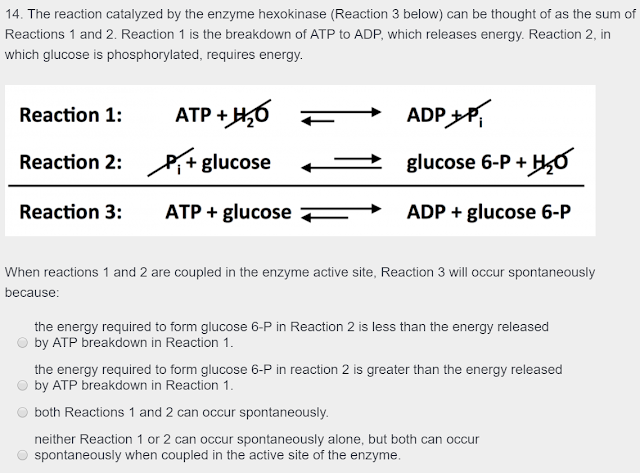

Reaction 1 release energy, and reaction 2 absorb energy. Therefore, everything else held equal, reaction 1 should occur by itself, by reaction 2 should not. So neither the last two choices are good. Looking at the arrows, it appears that the reaction overall release energy, therefore, it appears the answer should be the first choice.


I googled this one, polar molecule (or ions) had a hard time to go through the phospholipid bilayer, but for some unknown reason water does diffuse through, therefore the answer is (a). This is also important physiologically because the concentration gradient of sodium is used for neuro signalling.


This is basic plant biology. Plant can create oxygen through photosynthesis, with abundant carbon dioxide, they can fix the carbon in carbon dioxide and grow and produce the oxygen to survive, therefore the answer is the first choice.


Without knowing the actual photosynthesis mechanics, it could be the oxygen in the carbohydrate, or it could be the generated $ O_2 $, I honestly don't know.


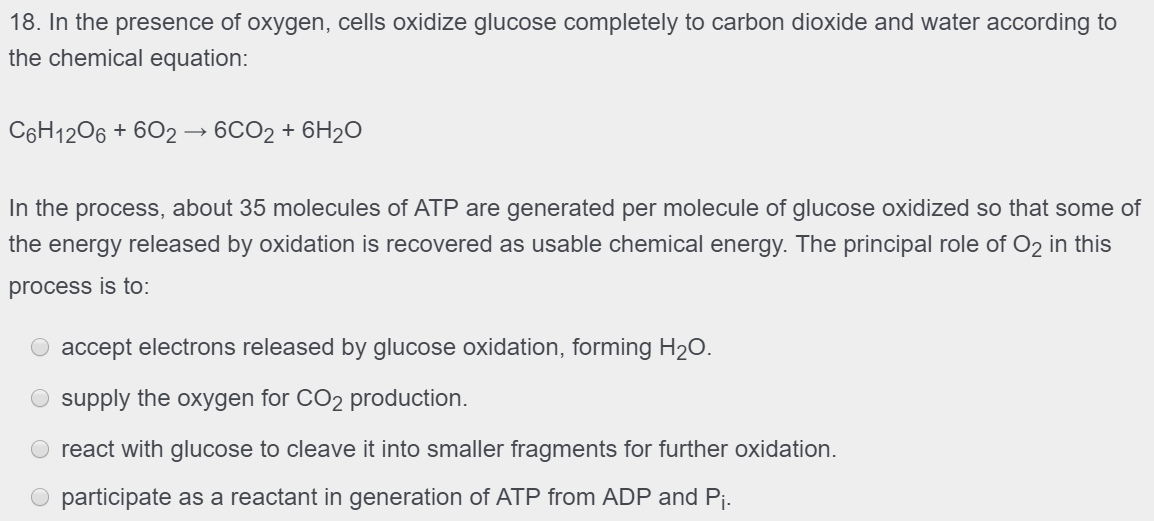
This is the concept of electron transport chain. $ O_2 $ is quite electronegative and therefore is used as the ultimate electron acceptor in order to build ATP.


I have no idea for this one - I know mitosis is the division of germ (i.e. sperm or egg) cells, but that's all.


 Since this is only the germ cell, it only make sense to have DNA from only one parent.


I also have no idea here :( It feels like a topic I never learnt before.


This one I roughly remember, gene transcription is the translation from DNA to RNA to prepare for protein synthesis.


No idea, I guess it would be human form on hexokinase? After all the bacteria cannot produce its own and is introduced with a human sequence there.


I guess it would be the first choice, this is really just a guess :(

The quiz ends here, it is a very long quiz, I have a lot of uncertainty. Overall I think this is just too hard for me, but I will try, anyway.

Monday, May 29, 2017

Special Relativity

I was so bored on a flight, so I borrowed a pen from my neighbor passenger and wrote a quick derivation of a few results in special relativity:

Suppose an observer is doing a light speed measurement on a train by measuring the time it takes to go upwards and then reflect back and measure the time elapsed, he measures the time elapsed to be $ 2t $ and the distance traveled to be $ 2h $.

But the train is moving, so to an observer outside of the train, he measures the light moved in diagonal manner, let the time spent to be $ t_0 $, and the overall distance the light traveled is $ 2\sqrt{(vt_0)^2 + h^2} $. We assumed the two observers measure the same $ h $ and the same $ v $.

Both measurements are speed of light, so they equals:

$ \frac{2h}{2t} = \frac{2\sqrt{(vt_0)^2 + h^2}}{2t_0} = c $

First, we cancel out all the $ 2 $.

$ \frac{h}{t} = \frac{\sqrt{(vt_0)^2 + h^2}}{t_0} = c $

Square the second equality to get

$ (vt_0)^2 + h^2 = c^2t_0^2 $

Rearranging, get 

$ h^2 = (c^2 - v^2)t_0^2 $

Dividing by $ c^2 $ get

$ \frac{h^2}{c^2} = (1 - \frac{v^2}{c^2})t_0^2 $

But $ \frac{h^2}{c^2} $ is simply $ t^2 $ by the first equality, therefore

$ t^2 = (1 - \frac{v^2}{c^2})t_0^2 $

or 

$ t = \sqrt{1 - \frac{v^2}{c^2}} t_0 $.

The equation shows a few things:

First, $ v \leq c $, for it does not make sense to have imaginary time. That indicates nothing can run faster than the speed of light.

Second, $ 0 \leq \sqrt{1 - \frac{v^2}{c^2}} \leq 1 $, therefore, the time interval between the same events is shorter for the observers on the train. Suppose $ t_0 = 1 $ second, then $ t $ is less than a second, so if there is a clock there, it doesn't tick yet. So for the observer outside the train, it appears that a moving clock go slower. This is called time dilation.

Third, since the both observers agrees on the relative velocity, the distance traveled, measured by the two observers are $ vt $ and $ vt_0 $ respectively. We know $ t \leq t_0 $, therefore, to the observer on the train, distance appears shorter as well. This is called length contraction.