online advertising

Tuesday, June 20, 2017

Introduction to Biochemistry - Quiz 2.1.2


The answer for the first part is (A) - this is the carboxyl carbon - it has a single bond to the alpha carbon, a single bond to the amine nitrogen, and a double bond to an oxygen, the double bond is what make it $ sp^2 $ hybridized.


The answer for the second part is (C) - this is the alpha carbon, the bond to hydrogen is implicit and is not drawn. 


The answer for the third part is (A) and (B) - this is the peptide bond, the bonding between the carboxyl carbon and the amine nitrogen.
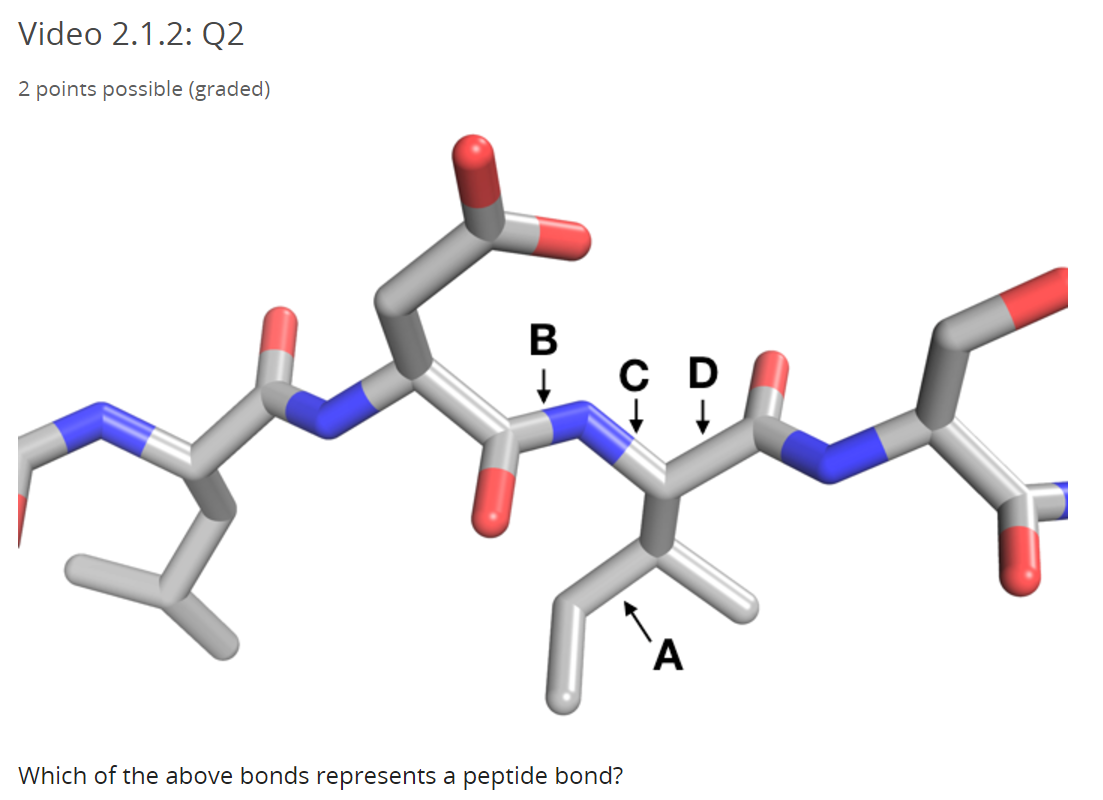


Just like the above, the peptide bond is the bond between the carboxyl carbon and the amine nitrogen, therefore the answer is (B)


Recall there is a resonance structure - a resonance structure is possible only if there is a double bond, therefore it is the double bond to $ O $, the electron can sometimes move to double bond with $ N $. Therefore the peptide bond does not rotate (as any double bond would). (A) is on the side chain so it is obviously not that.

Therefore the only remaining two bonds are (C) and (D) and they are the answer.


If it is all green, it should be an alpha helix.


The green shaded area can form alpha helix.
The blue shared area can form beta sheets.
All areas can form loops.
Therefore, the only possible answer is the last choice, the most common combinations of bond angles in proteins.


As stated above - all areas can form loops. Therefore the correct answer is to check them all!


It only make sense to group "like" things together, on the right hand side, we see some polar looking stuff with blue and red, therefore, it only make sense if the left hand side is non-polar. The side chains are pointing outwards, they can't help stabilizing the alpha helix (unless they clash into each other - in which they destabilize it) - so the first choice is wrong. The third choice is hard to tell, but for obvious reason the drawing included a short side chain, so that isn't true either. Non-polar stuff do not form hydrogen bond, so that's false as well. The only reasonable choice is the second one, so that's the answer.

As a side note - I have no idea why the answer stress that that side chains are aliphatic, I think it should be just fine even if the side chains contains a benzene ring, as long as it stays non-polar.


I did some searching on this one. Most amino acids has the trans configuration. That is to minimize steric hindrance. This implies the third choice is wrong. Flipping between cis and trans configuration for proline is known to be slow (and is often the rate determining step), so the fourth choice is wrong as well. While the second choice is unclear, the first one is definitely true, attached below we can see the proline structure, the usually exposed free hydrogen bonded with nitrogen is now participating in a ring, so it can't use that free hydrogen to hydrogen bond with the carboxylate oxygen to stabilize the helix. That's why the answer is the first choice.


Sunday, June 18, 2017

Introduction to Biochemistry - Quiz 2.1.1.2

This quiz is all about drawing amino acid structure using their molecule editor. Anyway, here are the results that got accepted.


Honestly, we are given all the structures, just draw it back again using the tool, not a very interesting exercise. Technically, the second drawing is not quite right, the hydrogen bonded to the alpha carbon should be a dash bond, but I can't make the molecule editor to draw a dash bond for me, so be it.


Introduction to Biochemistry - Quiz 2.1.1


(A) is the most tricky option, this is an amino acid with a wrong (i.e. D) configuration - so it won't be a natural amino acid.
(B) is glycine with the side chain being simply a hydrogen atom. It is the only amino acid that is achiral.
(C) looks like an amino acid except it has one more carbon - this is obvious if you compare it to (B).
(D) does not have an amine group at all, so it cannot be an amino acid.
(E) is the general amino acid from.

Therefore the answer is (B) and (E).


All these forces are Coulomb forces - the attraction between positive charge and negative charges. Ionic charge is the strongest because they are formal charges, the hydrogen bond is due to partial charges generated by the difference in electronegativity, and Van Der Waal's force is the weakest because it is just due to induced dipoles.

Therefore the answer is Ionic > Hydrogen Bond > Van Der Waals force.


As we have argued above on the strength of the interaction forces, the correct labeling, from top to bottom, should be Van Der Waal's Forces, Hydrogen Bonds and Ionic Bonds.

The energy values are negative because one can think of it as potential energy stored in a spring, if you compress or stretch, the spring would like to restore to what it was. If two atoms are bonded and we stretch them apart, the attraction force in the bond work against the move. Similarly, if we push two atoms in a bond too close the electron cloud repulsion would work against us. That's why we need to give energy in the system to change things, that's why the energy is negative.


Aspartic acid is an acid in physiological pH, which means it should lose a proton. The only feasible answer that lost a proton is either (B) or (C) - I think it should be (B) because at physiological pH the amine group should be basic and accepted the proton to begin with, it shouldn't lost it again just because it has a different side chain.


Here below is a summary of all the amino acid structures:


I failed this one on the first attempt, initially, I thought the smaller the side chain is, the more flexible it is, therefore the answer should be Alanine.

But that's not true, and it is the tricky part of this problem, it is asking about the flexibility of the side chain, not of the amino acid! Lysine have many bond that could be rotated and it is obvious that side chain is very flexible.


Even if I don't know what this molecule is, it is obviously not charged, so the only two options are Non Polar, Aliphatic, small or Non Polar, Aliphatic - is it small or not? I don't know. So I looked it up, it is not small, therefore the answer is Nonpolar, Aliphatic.

I don't know what is an Aliphatic compound is, so I looked it up in Wikipedia, I think it means organic compound without a benzene ring.

Saturday, June 17, 2017

Introduction to Biochemistry - End of session 1 assessment


I failed this one personally, that is a really stupid mistake :(
I was tricked by the fact that we are asking the opposite question as we did in the first quiz.
Of course, Oxygen and Nitrogen is more abundant in living organism than Icon, Silicon and Calcium.


The molecule is symmetric, therefore the difference in electronegativity $ (\Delta EN) $ is 0. The carbon has three electron domain, therefore it is $ sp^2 $ hybridized and is trigonal planar.


This molecule is NOT chiral because we have two identical hydrogen bonded to it.


This molecule is chiral. To see that, the lower right carbon is $ sp^3 $ hybridized and is bonded to four different groups.


The only difference between the left and right and that the left hand side of the molecule is flipped. The number of types of atoms does not change, therefore the chemical formula is the same.

Looking at the carbon atom that is at the hinge of the flip. It is impossible for the molecule to change from one to the other without breaking a bond, therefore it is a configuration change, not a conformational change.


Use inorganic molecule for chemical energy - i.e. Chemo
Fix carbon dioxide for backbone - auto

This bacteria is a chemoautotroph.


H is the internal energy - the total amount of energy in the system.


$ \Delta G = \Delta H - T \Delta S = -10 -(-15) = 5 $ Kj/mol, therefore the reaction is non-spontaneous.


Again, $ \Delta G = \Delta H - T \Delta S $, but in this case we are having a positive number minus a positive number, we do not know if the output will be negative or not. Therefore the answer is "It depends on the temperature". The hotter, the more favorable it would be.


$ K_{eq} = 4 = \frac{[P_{eq}]}{[S_{eq}]} $ implies when [S] is 10 M, [P] should be 40 M, but we have only 1M of [P], so the forward reaction is spontaneous. 


$ \Delta G = \Delta H - T \Delta S = 100 - (273 + 27) \times 0.333 = 0.1 $

If the temperature increase, the $ \Delta G $ will decrease, and therefore the reaction will be spontaneous.

Introduction to Biochemistry - Quiz 1.1.4


The available options are spontaneous and non-spontaneous. 

A reaction that has a negative free energy delta is spontaneous. Therefore the answer is spontaneous.


Again, the available options are spontaneous and non-spontaneous. 
We know $ \Delta G = \Delta H - T \Delta S = -10 - 15T < 0 $, therefore the answer is spontaneous.


This is basically the generalization of above, the free energy is always less than 0 in this case, and therefore the answer is still spontaneous.


$ K_{eq} = \frac{[P]}{[S]} $, that means at equilibrium, the concentration of [P] should be 4 times the concentration of [S], but right now we have 10M of [P], according to the Le Chatelier principle, the reaction will go backward, therefore the answer is that the forward reaction is non-spontaneous.


According to the Le Chatelier principle, the reduction of product should leads to production of product, therefore the reaction will go forward.


Remember the standard condition is not just the standard temperature, it is also the reactant has a concentration of 1M.

According to the equation $ \Delta G = RT\ln K_{eq} $, since $ K_{eq} = 1 $, $ \Delta G = 0 $. The reaction is at equilibrium because the concentration is all at 1M now (by the definition of standard condition).


Introduction to Biochemistry - Quiz 1.1.3


The chemo/photo classification corresponds to the energy source - it is easy to remember this by remembering photosynthesis is gathering energy.

The auto/hetero classification corresponds to carbon source for building 'body'. Autotroph uses carbon in carbon dioxide while heterotroph use carbon in food.

Therefore human is chemoheterotroph (for Q1) and bacteria is Photoheterotroph.


The equation is (G) free energy = (H) internal energy - (T) temperature times (S) entropy. Therefore the answers are

S is the disorder of the system, the amount of energy that cannot do work.
G is the amount of energy available to do work in the system.

Technically, I am not super happy with the description of S. It is not an energy, it is an energy per Kelvin, but anyway.

Suppose S is positive (e.g. decomposition), that higher the temperature, the higher the TS term, the lower the free energy term, meaning the reaction is more favorable in high temperature. That is why if we wanted to decompose molecule, we do that at high temperature.

Monday, June 12, 2017

Introduction to Biochemistry - Quiz 1.1.2


To put it simply, two different 3D structures are called conformations of each other if a molecule can transform from one to another without having to break a bond. Otherwise it is a configuration change.

Therefore, the first answer is:

"The (potentially flexible) spatial arrangement of atom around fixed bonds in a molecule"

And the second answer is:

"The fixed arrangement of atoms dictated by bonds of a molecule"


The molecule is chiral - a molecule is chiral if there exists a carbon atom such that it is bonded to 4 different groups. Such an atom could be bonded differently (e.g. swapping the H and F in the question) to form another molecule, that molecule is in a different configuration but it is impossible to superimpose the two molecules.


It is also chiral, and it has a lot of chiral centers

This is a little tricky - the answer is no. The drawings are exactly the same thing.