online advertising

Friday, December 22, 2017

Introduction to Biochemistry - End of session 3.4, 3.5, 3.6 assessment


NADH and FADH2 are the electron donors.


Whether or a compound activate, inhibit or does not impact a catalyst is a fact, one need just need to know about it. But these facts make biological sense to maintain homeostasis, therefore we can analyze it from a negative feedback standpoint.

Pyruvate Dehydrogenase (PDH) catalyze the conversion from Pyruvate to Acetyl CoA

CoA  indicate we have abundant reactant, so it should activate PDH.
Acetyl-CoA indicates we have abundant product, so it should inhibit PDH.

Acetyl-CoA starts the citric acid cycle. Therefore it favors energy production.

AMP indicates a low energy state, so it should activate PDH.
ATP indicates a high energy state, so it should inhibit PDH

The citric acid cycle produce NADH from NAD+, therefore

NADH should inhibit PDH
NAD+ should activate PDH

Fatty acid activates PDH, not sure why, but the answer say it does. As we said earlier, it is a fact.

I personally hate this type of problem that requires memorization, and I lose a lot of points from this one :(


I remember Glucagon activates PDK. It make sense for Glucagon to reduce citric acid cycle, so I think it is PDK inactivates PDH, then it must be true that PDP activates PDH.

I checked, while it make sense for calcium (released in muscle for contraction) to activate citric acid cycle, it does so by activating PDP, not by acting on PDH itself.

Therefore the answers are:

PDH is inactivated by the action of PDK (Pyruvate Dehydrogenase Kinase)
PDH is activated by the action of PDP (Pyruvate Dehydrogenase Phosphatase)


Pyruvate is oxidative decarboxylated to form Acetyl-CoA, that release one molecule of carbon dioxide, but this is outside of the citric acid cycle, do not count this one.

Isocitrate is oxidative decarboxylated to form alpha-ketoglutarate, that release one molecule of carbon dioxide.
alpha-ketoglutarate is oxidative decarboxylated to succinyl-CoA, that release one molecule of carbon dioxide.

Therefore a turn of citric acid cycle release 2 molecules of carbon dioxide. An easy way to note is that two carbons enters the cycle, so two carbons must exit, and the only way to exit is through carbon dioxide.

Isocitrate to alpha-ketoglutarate generate 1 molecule of NADH.
alpha-ketoglutarate to succinyl-CoA generate 1 molecule of NADH.
Malate to oxaloacetate  generate 1 molecule of NADH.

Therefore a turn of citric acid cycle generate 3 molecules of NADH.

Succinate to Fumarate generate 1 molecule of FADH2.

Therefore a turn of citric acid cycle generate 1 molecule of FADH2.


Using the OIL RIG mnemonics, we know that NAD+/FAD does not have the extra electrons and therefore is ix the oxidized state. NADH and FADH2 is in the reduced state.

NADH is reduced into NAD+, two electrons are transferred
FADH2 is reduced into FAD, two electrons are transferred.

Therefore each of these carrier can transfer two electrons at once.
In fact, the half reaction in the next problem shows that is the case for NAD+.


The first half reaction is going in reverse direction and the second half reaction go in forward direction, therefore, the standard reduction potential is simply $ -(-0.320) + 0.045 = 0.365 $.

The standard free energy can be computed using the formula $ \Delta G = -nF\Delta E = -2 \times 96.5 \times 0.365 = -70.445 $, make sure we get the sign correct, a positive reduction potential leads to a negative free energy change.

The free energy change is negative and therefore the reaction is spontaneous.


Complex I accepts electrons from NADH, while complex II accepts electrons from FADH2. Complex III accept electrons from Ubiquinol, while complex IV accepts electrons from cytochrome C.

Memonics - Ubiquinol (-ol) is the alcohol and therefore is the reduced form of Ubiquinone (-one), a ketone.


FCCP destroy the proton gradient, so ATP is not synthesized. The electron transport chain will simply function as usual.


Cyanide blocks the electron transport chain, so oxygen is not consumed. We have no proton gradient, so ATP is not synthesized.


Oligomycin blocks ATP synthase, so ATP is not synthesized, eventually, the proton gradient is built up too much so the electron transport chain will also stop, so oxygen is not consumed.


The $ \beta $ subunit of the $ \alpha\beta $ ring.


You need 15 protons to make a turn, a turn can synthesize 3 ATPs, so it need 5 proton flows to synthesize 1 ATP.


They do that through the glyoxylate cycle, it is essentially this:

Modifying their citric acid cycle by skipped two steps that include carbon dioxide production for partially diverting the intermediates to glucose synthesis.


Step I, Acetyl Coenzyme-A is combined with oxaloacetate to form citrate, and
Step IV, Acetyl Coenzyme-A is combined with glyoxylate to form malate.

(I forgot about step IV when I revisit this problem, need to try harder to memorize things)


The first one catalyze step III and is called isocitrate lyase, the second one catalyze step IV and is called malate synthase.

The molecule in the blank box that remains and feeds the cycle is called glyoxylate, and the molecule in the blank box that leaves the cycle is called succinate.


In the glyoxylate cycle, 2 acetyl-Coenzyme A is needed to create 1 oxaloacetate. 1 oxaloacetate is needed to create 1 phosphoenolpyruvate, and 2 phosphoenolpyruvate is needed to synthesize 1 glucose. So we need 4 acetyl-Coenzyme A molecule to synthesize 1 glucose molecule.


Plant has glyoxysome, a specialized organelle for the glyoxylate cycle.

The glyoxysome does the first step, assimilate acetyl coenzyme A to form glyoxylate and excess succinate.

The rest of the citric acid cycle happens in the mitochondria as usual.

The gluconeogenesis pathway happens in the cytoplasm.


When pathogen challenge via infection, the immunoresponsive genes are upregulated, this leads to itaconic acid production, itaconic acid inhibits the isocitrate lyase, and finally inhibits the glyoxylate cycle.


Step I, II, VI, VII, VIII are shared, the only not shared reactions are the step III, IV and V. III and IV are key steps to skip because they lost carbon through oxidative decarboxylation, step V is skipped simply because we don't have Succinate-Coenzyme A.


Obviously, B cannot do the glyoxylate cycle, it just die when there carbohydrate is scarce, both A and C can do glyoxylate cycle.

In addition to that, C can survive itaconic acid, so C can survive immune response.

Thursday, November 23, 2017

Introduction to Biochemistry - Quiz 3.6.3


By stabilizing ATP in an ATP-ATP synthase complex with a free energy similar to the ADP-ATP synthase complex.


The T (tight) conformation.


The O (Open) conformation.


3


The transport of ATP out of the mitochondria [How could the proton motive force help with this? Proton wants to get in the matrix cannot drive anything to get out]

The transfer of protons into the intermembrane space by the electron transport chain. [This is obvious because it works against the proton motive force]

Introduction to Biochemistry - Quiz 3.6.2


It holds one component of the ATP synthase still so that it cannot rotate with respect to the stalk.


It rotates as protons pass through the a chain and transfers rotation to the asymmetric stalk.


It forms the asymmetric 'stalk' that changes the conformation of the ATP synthase.


The c-ring and the a chain.

Introduction to Biochemistry - Quiz 3.6.1


The given reaction is the sum of the first half reaction reversed and the second half reaction, therefore, the $ \Delta E^{t_0} $ is $ -(-0.320) + 0.82 = 1.14V.

Overall, there is two electron transferred, therefore n = 2. Using the formula $ \Delta G = -nFE $, we get the answer $ 2 \times 96.5 \times 1.14 = -220.02 $

A negative change of free energy means the reaction is spontaneous.


The system preserved 200/220 ~= 90% of energy that is derived from the redox reactions. Compare to a typical car engine which is only 10% - 50% efficient, I'd say the electron transport chain is amazingly efficient.


The exergonic transport of electrons is directly coupled to the endergonic transfer of protons from the mitochondrial matrix to the intermembane space.


The exergonic movement of protons from the intermembane space to the mitochondrial matrix is coupled to the endergonic process of ATP synthesis.


FCCP destroyed the proton gradient and therefore we cannot ATP synthesis is not supported.


The pH 7 solution created the proton gradient and valinomycin, by being able to take potassium [but not chloride] ion out of the mitochondrial matrix, also created a charge gradient, this two things together support ATP synthesis.


We do not have a proton gradient here so it does not support ATP synthesis.


The cyanide block the electron transport chain, but since we have an artificial proton gradient build up, we do not need the electron transport chain, so it still support ATP synthesis.


Oligomycin blocks ATP synthase, so regardless of the artificial proton gradient the setting will not support ATP synthesis.

Sunday, November 5, 2017

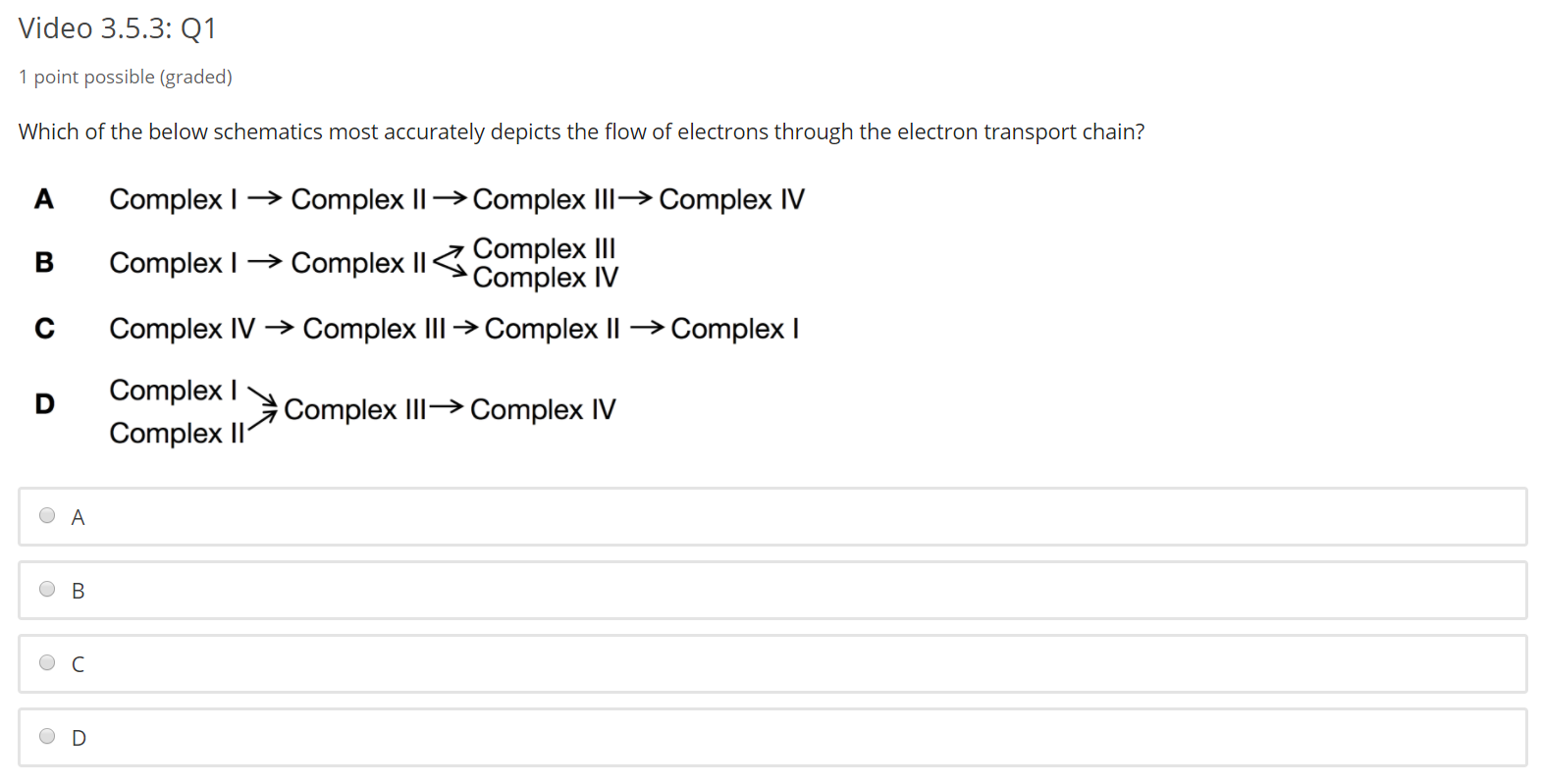
Introduction to Biochemistry - Quiz 3.5.3


The correct answer is D.

Complex I and Complex II takes electrons from NADH and FADH2 respectively and transfer them to Coenzyme Q. Complex III take electrons from reduced Coenzyme Q to cytochrome C. Finally, Complex IV takes electron reduced cytochrome C to oxygen.


NADPH - this molecule is not involved in the electron transport chain.


$ O_2 $


Protons are transmitted across the mitochondrial membrane by the ETC, building up a gradient which is used to drive ATP synthesis.


To transfer a single electron to cytochrome c from the double electron carrier QH2.


To transfer electrons from universal electron acceptors to coenzyme Q.


Here are the equations for the electron transfer steps:

NADH + 5H(m) + Q -> NAD+ + QH(2) + 4H(i)
QH(2) + 2CYTC(ox) + 2H(m) -> Q + 2CYTC(red) + 4H(i)
4CYTC(red) + 8H(m) + O2 -> 4CYTC(ox) + 2H2O + 4H(i)
Taking the double of the first two equations, we get: 
2NADH + 10H(m) + 2Q -> 2NAD+ + 2QH(2) + 8H(i)
2QH(2) + 4CYTC(ox) + 4H(m) -> 2Q + 4CYTC(red) + 8H(i)
4CYTC(red) + 8H(m) + O2 -> 4CYTC(ox) + 2H2O + 4H(i)
And then sum them up, we get

2NADH + 10H(m) + 2Q + 2QH(2) + 4CYTC(ox) + 4H(m) + 4CYTC(red) + 8H(m) + O2

-> 

2NAD+ + 2QH(2) + 8H(i)  2Q + 4CYTC(red) + 8H(i) + 4CYTC(ox) + 2H2O + 4H(i)

Therefore the answers are:
20 protons
2 molecules of water, and
1 molecule of oxygen
The number of protons worth a little more discussion here, obviously, we consumed 22 free protons in the matrix and produced 20 free protons in the intermembrane space. We count that as pumped 20 protons, we could as well say we pumped 22. The two protons, together with the two disassociated from the NADH, are used to form water.

Introduction to Biochemistry - Quiz 3.5.2


It means the reaction has a negative free energy - which means the reaction is spontaneous.


The reaction under question is the first reaction goes in reverse and the second reaction goes in forward, therefore, the $ \Delta E^{t_0} = 0.220 - 0.077 = 0.143 $.

The free energy can be computed using $ \Delta G = -nFE = -1 \times 96.5 \times 0.143 = -13.7995 $

A negative free energy indicates the reaction is spontaneous.


Oxidation is Loss - Reduction is Gain (OIL RIG)

During the first electron transfer, the first electron donor is oxidized and the second electron donor is reduced, therefore, the reaction has a reduction potential given by $ \Delta E = E_2 - E_1 $, where $ E_1 $ is the reduction potential of the first electron donor and $ E_2 $ is the reduction potential of the second electron donor.

In order for these reaction to be spontaneous, these reduction potential must be all positive, in other words, $ E_1 < E_2 $.

Therefore, the correct answer is:

Sort them according to their physiological reduction potential (E), lowest to highest.


We have already outlined the theoretical approach in the previous problem, basically, order them according to the reduction potential (the standard condition here is irrelevant, what is relevant is the condition in the cell).

An experimental approach would be to disrupt some known steps in the electron transport chain. If the chain is disrupted, then there wouldn't be consumption of oxygen or production of ATP, but definitely we should still see changes in oxidation states.

Therefore the correct answers are:

Rank the electron carriers in terms of their reduction potential ($ \Delta E $), and
Treat the cells with drugs to disrupt known steps in the electron transport chain and observe the oxidation state of each electron acceptor/donor.


This is fully oxidized Coenzyme-Q (also known as Q or ubiquinone).
The -one prefix reminds me about the ketone, with the two double bond O pointing outward, in reduced state, these ketone group are reduced into hydroxyl group.


It is obviously not a coenzyme Q.
It is not an iron-sulfur center as there is no sulfur.
The only sensible answer is that is a a heme.
Therefore the answer is

A heme functional group, the redox component of the cytochromes.

Introduction to Biochemistry - Quiz 3.5.1


The mitochondrial inner membrane - the electrons are transferred from the mitochondrial matrix to the intermembrane space.


The exergonic transfer of electrons powers the transfer of protons into the intermembrane space. The protons flow down their concentration gradient to power the endergonic synthesis of ATP.


The accept electrons from intermediates of the citric acid cycle, and
They donate electrons to the electron transport chain.


NADPH is different from NADH, they do not donate electrons to the electron transport chain, they donate electrons to power anabolic reactions in the cytosol.