This is a quiz the course asks me to take before learning. I believe this is meant for testing if I have the knowledge required for the course, I had a really hard time with this set of questions. But I am sharing it with us anyway. The quiz do not provide feedback, therefore here is the best I could do, I do not claim the answers are correct, since I really don't know.





I think the answer is the 4th option - because I don't think anti-biotic is actively changing the species. It is probability just because bacteria reproduce fast, so it is easier for us to see the effect of evolution.

I googled - bacteria do not have a nuclear membrane.

This one I vaguely remember - virus can use RNA as genetic material.


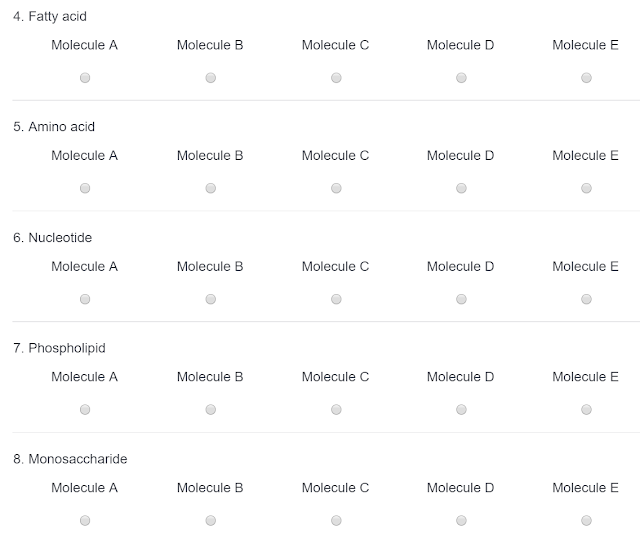
Molecule E is fatty acid, I remember the acidic head and the long tail. Molecule D is the amino acid with the amine group and the carbonxyl group. I don't know what is a nucleotide look like, but it is obvious that Phospholipid need Phosphorus, so that's molecule A. Monosaccharide is simple sugar and that is the ring structure molecule C. Therefore we know molecule B is nucleotide.

This one I know, phospholipid bilayer are cell membranes and it looks like A. Water is polar, and therefore the hydrophillic parts goes together and the hydrophobic parts goes together like that naturally.

This is basically talking about the same principle - the non-polar part do not like water and therefore get folded inside while the polar part stay outside.

Because the reactant and the product are the same, the end energies are the same. The enzyme cannot change that, therefore the answer is (b). The enzyme reduces the activation energy and therefore speed up the reaction.

I am quite uncertain with this one. With reference to the diagram above, enzyme only change the rate of the reaction, which means the answer should be slower rate. But practical experience also tell us starch do not decompose itself into glucose in standard condition by itself. So I am debating whether the answer is the 1st or the 2nd choice :(

By definition, it is at equilibrium, so concentrations do not change. The reactions are both proceeding at the same rate, so the second choice is correct. The third choice isn't, as both reactions are actually proceeding. The last choice I am uncertain. The free energy is $ RT \ln k_{eq} $, wonder how it can be zero.

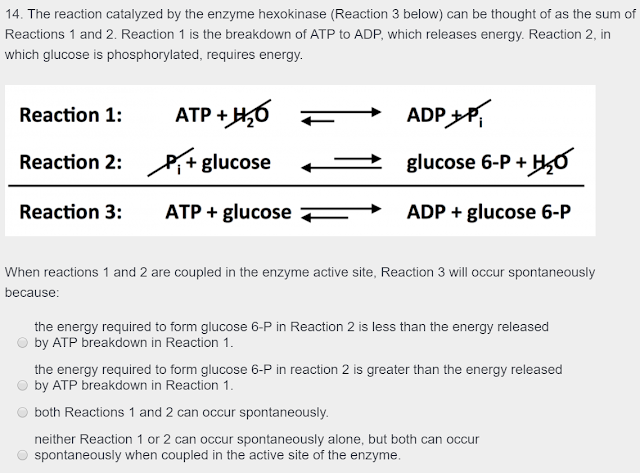
Reaction 1 release energy, and reaction 2 absorb energy. Therefore, everything else held equal, reaction 1 should occur by itself, by reaction 2 should not. So neither the last two choices are good. Looking at the arrows, it appears that the reaction overall release energy, therefore, it appears the answer should be the first choice.

I googled this one, polar molecule (or ions) had a hard time to go through the phospholipid bilayer, but for some unknown reason water does diffuse through, therefore the answer is (a). This is also important physiologically because the concentration gradient of sodium is used for neuro signalling.

This is basic plant biology. Plant can create oxygen through photosynthesis, with abundant carbon dioxide, they can fix the carbon in carbon dioxide and grow and produce the oxygen to survive, therefore the answer is the first choice.

Without knowing the actual photosynthesis mechanics, it could be the oxygen in the carbohydrate, or it could be the generated $ O_2 $, I honestly don't know.

This is the concept of electron transport chain. $ O_2 $ is quite electronegative and therefore is used as the ultimate electron acceptor in order to build ATP.

I have no idea for this one - I know mitosis is the division of germ (i.e. sperm or egg) cells, but that's all.

Since this is only the germ cell, it only make sense to have DNA from only one parent.

I also have no idea here :( It feels like a topic I never learnt before.

This one I roughly remember, gene transcription is the translation from DNA to RNA to prepare for protein synthesis.

No idea, I guess it would be human form on hexokinase? After all the bacteria cannot produce its own and is introduced with a human sequence there.

I guess it would be the first choice, this is really just a guess :(
The quiz ends here, it is a very long quiz, I have a lot of uncertainty. Overall I think this is just too hard for me, but I will try, anyway.

I googled this one, polar molecule (or ions) had a hard time to go through the phospholipid bilayer, but for some unknown reason water does diffuse through, therefore the answer is (a). This is also important physiologically because the concentration gradient of sodium is used for neuro signalling.

This is basic plant biology. Plant can create oxygen through photosynthesis, with abundant carbon dioxide, they can fix the carbon in carbon dioxide and grow and produce the oxygen to survive, therefore the answer is the first choice.

Without knowing the actual photosynthesis mechanics, it could be the oxygen in the carbohydrate, or it could be the generated $ O_2 $, I honestly don't know.
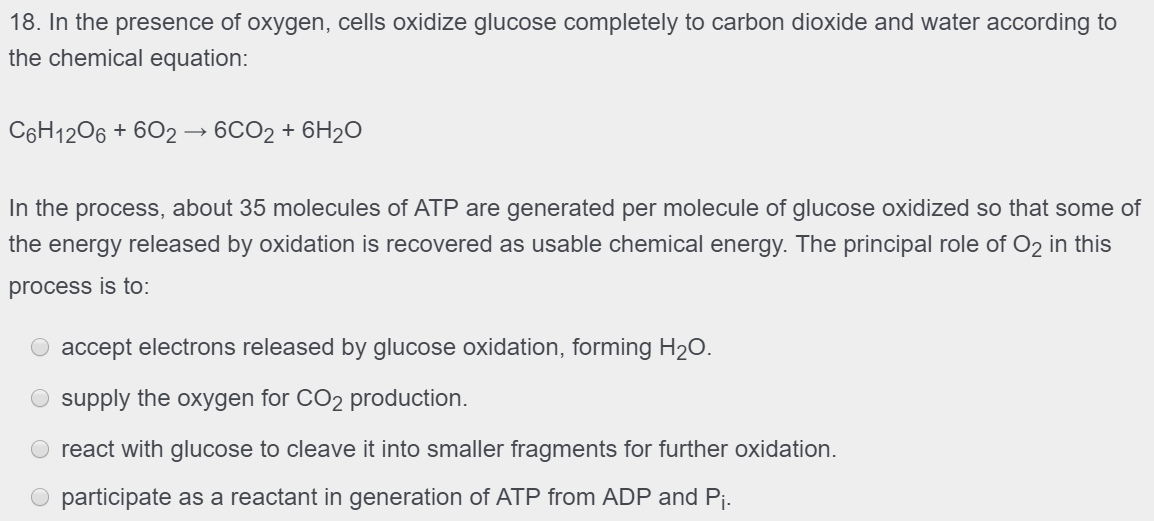
This is the concept of electron transport chain. $ O_2 $ is quite electronegative and therefore is used as the ultimate electron acceptor in order to build ATP.

I have no idea for this one - I know mitosis is the division of germ (i.e. sperm or egg) cells, but that's all.

Since this is only the germ cell, it only make sense to have DNA from only one parent.

I also have no idea here :( It feels like a topic I never learnt before.

This one I roughly remember, gene transcription is the translation from DNA to RNA to prepare for protein synthesis.

No idea, I guess it would be human form on hexokinase? After all the bacteria cannot produce its own and is introduced with a human sequence there.

I guess it would be the first choice, this is really just a guess :(
The quiz ends here, it is a very long quiz, I have a lot of uncertainty. Overall I think this is just too hard for me, but I will try, anyway.


