online advertising

Tuesday, July 4, 2017

Introduction to Biochemistry - Quiz 2.4.2


Obviously, it is [S], this is something we have control.


At the beginning of the reaction, the concentration of product is so low that the reverse reaction from product to enzyme substrate complex is negligible.


According to the michaelis and menten equation, it is

$ V_0 = \frac{V_{max}[S]}{k_m + [S]} = \frac{V_{max}k_m}{k_m + k_m} = \frac{V_{max}}{2} $.

Therefore the answer is:

Initial velocity is equal to one-half $ V_{max} $.


Despite the long question, this question is stupid, it is really just substituting the given equation.

Introduction to Biochemistry - Quiz 2.4.1


In this experiment, the product has color, it is easy to measure its through optical means - therefore we are measuring the appearance of product.

In a typical experiment, we do not know how much enzyme is needed, so if we want $ V_{max} $, we simply have a lot of substrate - then enzyme will most likely be the limiting factor.

Therefore the answer is:

In this experiment, the enzyme velocity is measured by the appearance of the enzyme's product.
In a typical experiment, the substrate is in excess, and the velocity will be measured quickly after initiating the experiment.


There is a maximum velocity because as substrate concentration increases, availability of enzyme is going to be the limiting factor, that's why the answer is:

At high substrate concentrations, the enzyme is saturated and cannot catalyze any faster.

Without enzyme - the reaction is practically not happening, so that rate increase due to substrate concentration can simply be ignored.

Introduction to Biochemistry - Quiz 2.3.5


The key difference of MRI from CT or PET is that it does not require the use of ionizing radiation. When exposed to magnetic field, hydrogen atom resonance at a certain frequency and emit electromagnetic radiation, this is dependent of the hydrogen in various tissues, so this is how MRI create images.

The correct answers are:

Contrast is achieved in MRI by different magnetic properties water across tissues.

MRI uses a combination of magnetic fields and radio frequency to detect hydrogen atoms in water molecules.


Because MRI use magnetic resonance, it does not need radioactivity or fluorescent properties. Material with strong magnetic properties are often heavy metal and is therefore toxic, we need chelator to make sure it does not harm the subject.

The correct answers are:

MRI probes are composed of heavy metal atoms can be used as tiny magnets

MRI probes are surrounded by a chelator that shields the body from the toxicity of heavy metal and promote their excretion by the kidneys.


There are millions of patients of thrombus, so it is not rare, it is too much blood clot, so it cause problem by blockage, not bleeding. Stroke/Hypoxia are caused because there is no/reduced blood flow, not by bleeding.

Therefore the correct answers are:

A thrombus is a blood clot that forms in arteries or veins of the body.

A thrombus can lead to vessel blockage, causing hypoxia in coronary arteries.


The idea of phage screen is to use in-vitro selection of bacteriophages to find out which gene leads to protein that binds. This is a mouthful of jargons. Here is what it means:

Bacteriophages are viruses that infect bacteria. Some of these bacteriophages binds to fibrinogen, these are unwanted, so we eliminate them, some of these bacteriophages does not bind to fibrin, these are also unwanted, so we eliminate them as well. That is selection. These bacteriophages are cultured again and we repeat this experiment again and again, that allow evolution to pick the best gene that binds to fibrin but not fibrinogen.

We wanted to have as many iterations as possible to give good specificity, the experiment can help us to find which gene can bind to fibrin specifically. The key tricky part is the second and the third options, turn out, none of them are correct - Bacteriophages is neither eukaryotic virus nor siRNA.

The correct answers are:

Repeated cycling of fibrinogen and fibrin binding experiments improve phage sensitivity and specificity to fibrin.

The main advantage of using a phage library is linking the genetic code of a protein to its protein-binding properties.

Introduction to Biochemistry - Quiz 2.3.4.2

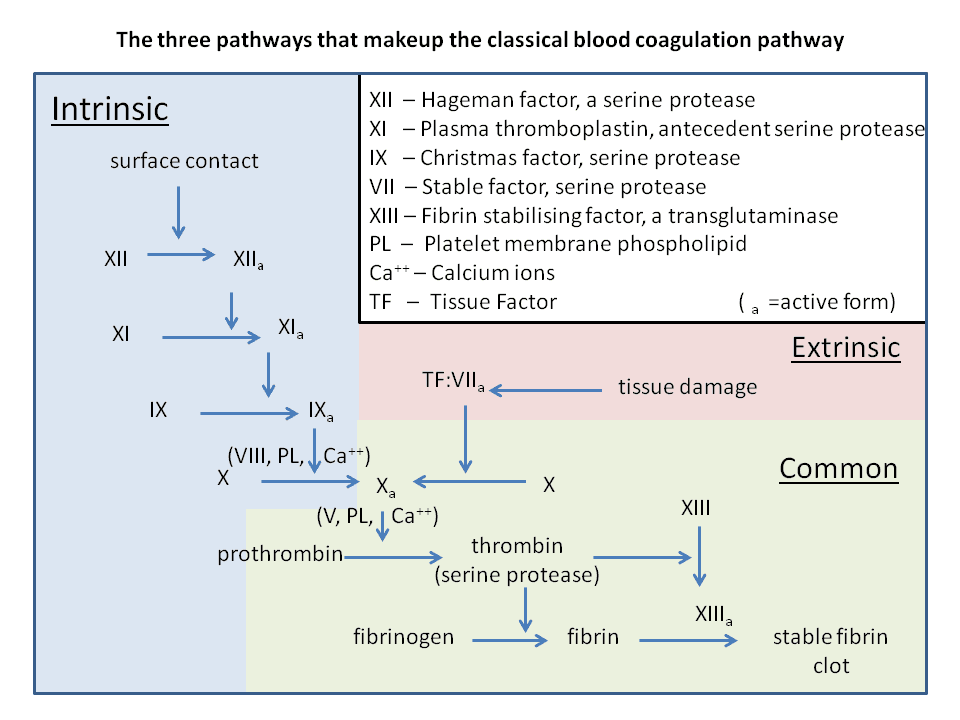
This whole quiz is about blood coagulation, this diagram on Wikipedia helped me a lot.

Here are the problems:


This question confused me a bit, thrombin is not cleaved? It is used in both the activation and the regulation of the coagulation cascade. It looks like the question is asking which protein "activates" thrombin (or the cleaving of prothrombin), that should be factor X, and that's the correct answer.


This is easy by looking at the diagram:

Factor XII is intrinsic
Factor VII is extrinsic
Tissue Factor is extrinsic


I was confused the factor VII with von Willebrand factor, they are not the same thing, so it does not require physical force to stretch it. It also got activated when exposed to tissue factor, not air.

Therefore the correct answer is:

The endothelium forms a barrier between tissue factor and blood so that it cannot bind to its ligand, factor VII.


The platelets found in the core of a blood clot contains the protein fibrin and are thrombin-dependent while those in the shell have little or none of this protein.

I generally hate memorizing, but I remembered this one.


Initiation - at initiation vWF binds collagen and unfold by the force to start attracting platelets.


TFPI inhibits tissue factor activity. The remaining plays a role in the stopping on the coagulation cascade but does not inhibit tissue factor itself.


Factor X is supposed to interacts with thrombin, but there is to fibrin forms, so it is most likely that thrombin lost its capability to cleave fibrinogen to form fibrin.


If fibrin cannot be formed, blood clot cannot be formed, so it is causing hemophilla.

Sunday, July 2, 2017

Introduction to Biochemistry - Quiz 2.3.4.1


A zymogen is an inactive precursor of an enzyme that can be hydrolyzed into an active enzyme. It is also called proenzyme.


My analysis is the following, both the timing and the location is important, while I don't know what the third choice is, it has to be correct. Therefore the answer is "All of the above". I googled a bit - proteome is simply the set of all proteins.


A signaling sequence is a sequence for secretion of a protein found in a leader peptide at the N-terminal of a protein. It is used to lead the protein to its destination organelle after it is synthesized.


The inactive form of chymotrypsin is called chymotrypsinogen. It is stored in the pancreas.


The ile faces towards the exterior of the protein in chymotrypsinogen. When the chymotrypsinogen is cleaved at ile by trypsin the ile turns inwards and forms an ionic bond with Asp194 inducing a conformational rearrangement that activates the enzyme.


Proinsulin is the inactive precursor of insulin.


First the signal peptide is cleaved, then Proinsulin formed. Aften that, the c-peptide is cleaved and both the insulin and c-peptide are excreted.

Friday, June 30, 2017

Introduction to Biochemistry - Quiz 2.3.3


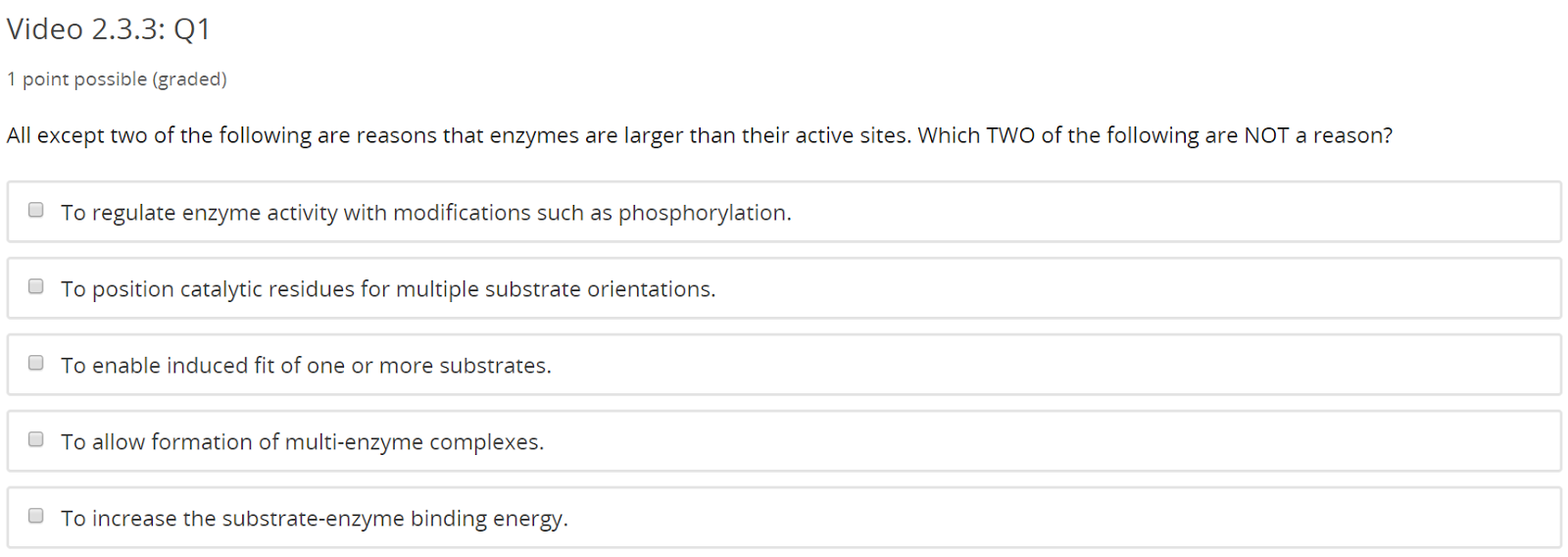
To start with, note the "NOT" in the question, that's tricky. The last option is obviously NOT a reason, increasing energy cannot help catalyst. The second option is NOT a reason too, because if catalytic residues allows for multiple substrate orientations, it is harder for the reaction to occur than when the substrate is only in a single orientation. Therefore the answers are

To position catalytic residues for multiple substrate orientations, and
To increase the substrate-enzyme binding energy.

Again these are NOT a reason for the enzyme to be larger than their active sites.


The problem with short peptide is that these catalytic residues are not properly positioned. Therefore the answer is

The constrained folding of the short peptide chain prevents the catalytic residues from being properly positioned.


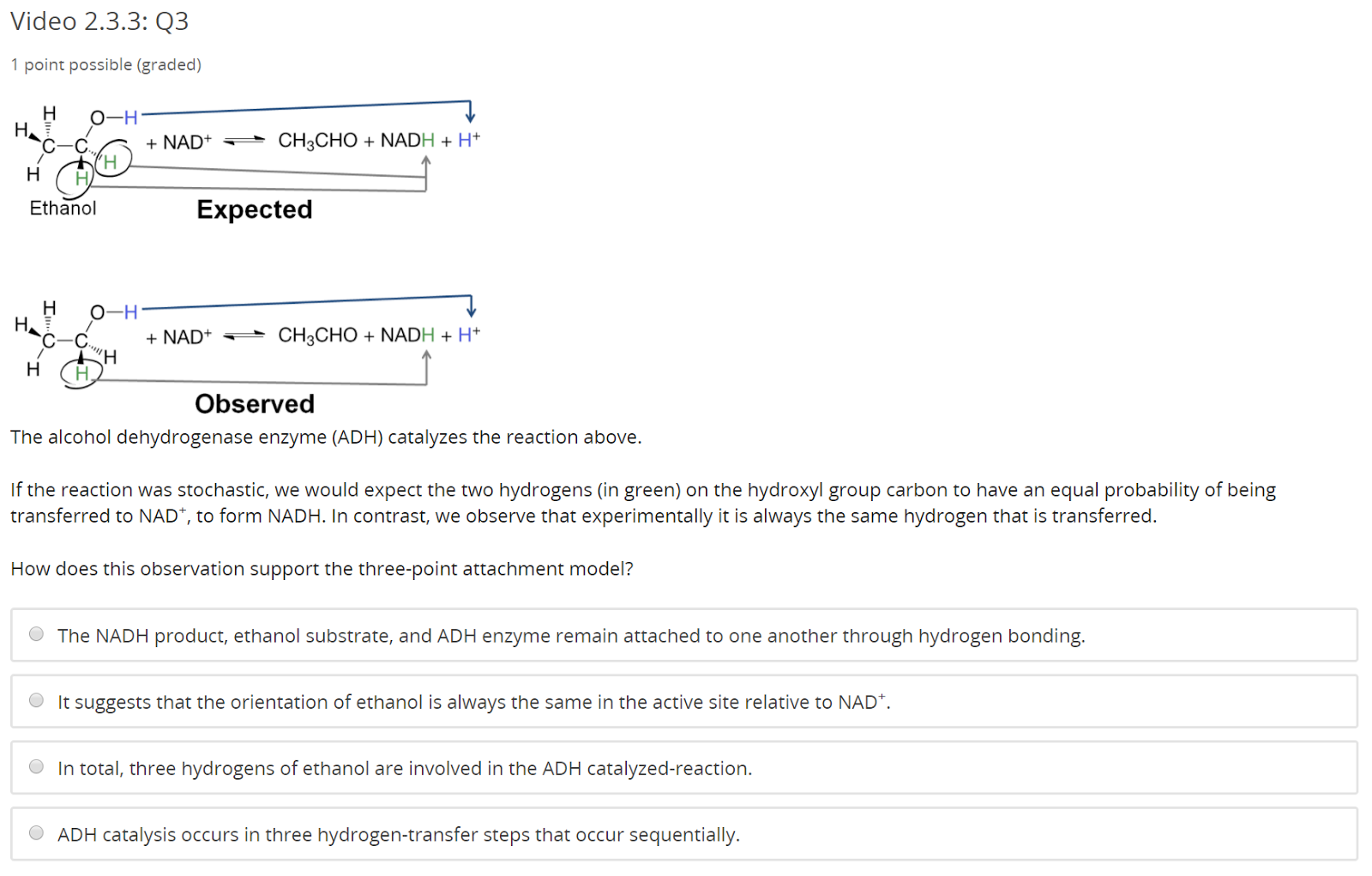
The reason why we always use the same hydrogen is because the reaction always happen by the enzyme fixed the position of ethanol and NAD$^+$ is a fixed orientation and then the reaction occurs.

Therefore the answer is:

It suggests that the orientation of ethanol is always the same in the active site relative to NAD$^+$


There are only two induced fit, oxaloacaetate binds first, so we know option 2 and 4 are wrong. Option 3 seems plausible, but the correct answer is option 1 - Oxaloacetate binding triggers a conformational change to promote acetyl-Co A binding.

I don't have a firm reason why option 3 is incorrect though.

acetyl-coA is less stable than oxaloacetate, this is the reason why the enzyme binds to oxaloacetate first.


I cheated and Googled this one. These three amino acids are particularly used for phosphorylation. Phosphorylation is the addition of a phosphate from an ATP molecule. Additional phosphate often cause enzyme to change activity and thus regulation.

Therefore the answer is:

These residues are phosphorylated to regulate enzyme activity.

Tuesday, June 27, 2017

Introduction to Biochemistry - Quiz 2.3.2


Enzyme catalyze reactions by making
"Weak non-covalent interaction between enzyme and substrate" and
"Transient covalent bond between enzyme and substrate".

So those are the answers.

Permanent bond would be useless for catalyzing reaction.
Binding energy is the result of these interactions.
Re-solvation is not defined.


D is the binding energy - this is the reduction of free energy in the transient state.


B is the activation energy of the enzyme catalyzed reaction.


I failed this one, twice, I still do not understand, the answer is

Weak non-covalent interaction between substrate and enzyme, and
Energy from desolvation of the substrate.

What I don't understand is if "Weak non-covalent interaction between substrate and enzyme" is an answer, then why "Transient covalent interaction that position the substrate in the active site" not an answer?

Overall - I am just confused by my "type-checker" - an energy is energy, an interaction and an interaction, type mismatch! And interaction can lead to the reduction of energy, sure, but an interaction is not an energy!


Desolvation is the process of replacing environment - substrate bonds with substrate - enzyme bonds.