online advertising

Sunday, August 27, 2017

Introduction to Biochemistry - Quiz 2.6.3


During the formation of glycosidic linkage, the hemiacetal group of one cyclized monosaccharide reacts with the hydroxyl group of a second monosaccharide.

These groups reacts and form acetal, that is the glycosidic linkage.


A sugar is reducing only if it has an exposed hemiacetal/hemiketal group. In A and D, the rightmost carbon expose the hemiacetal group. In C, the rightmost carbon is not a hemiketal group because it doesn't have an hydroxyl group attached to it.


The answer is E - the rightmost carbon has a hemiacetal group that allows it to react with other hydroxyl groups.


The anomeric carbon has number 1 for aldose - this happens only on B.


Remember the anomeric carbon is carbon 2 for ketose, the glycosidic linkage bonds the two anomeric carbon together, therefore it is a 1,2 glycosidic linkage.


The answer is D and E

D is a 1,1 glycosidic linkage, two anomeric carbons of two aldoses are bonded together
E is a 1,2 glycosidic linkage, again, the anomeric carbon of an aldose and the anomeric carbon of a ketose is bonded together.


Glycogen synthase catalyze the formation of the chain, therefore it is 1,4 glycosidic linkage.


Glycogen synthase can join a UDP-Glucose to the non-reducing end of glycogen to elongate the chain.


The reducing end of a glycogen chain has the hemiacetal group.

Saturday, August 26, 2017

Introduction to Biochemistry - Quiz 2.6.2


If glucose has a reducing aldehyde group, it should re-color the Schiff reagent, therefore the answer is

Glucose does not have a reducing aldehyde group.


The carbons are numbered from top to bottom. The alcohol group attached to carbon 5 is going to attack the carbonxyl carbon C1 to form hemiacetal.

That way the ring would be a 6-member ring and I believe that has least strain.


The anomeric carbon is the carbonxyl carbon, therefore the answer is C.


Depending on whether the C5 hydroxyl group attacks the front or back of the anomeric carbon, it will yield different isomers.


Pyran is a 6 member ring and furan is a 5 member ring. The answer is the number of carbon and oxygen atom in the ring.

Friday, August 4, 2017

Introduction to Biochemistry - Quiz 2.6.1


They contain multiple hydroxyl groups and they contains an aldehyde or ketone group.


Ribose and Glucose are monosaccharides.


Ketose must contain a ketone group, a ketone group is a C double bond O NOT at the end of the carbon chain, C is the only molecule with that structure.


$ C_1 $ has two hydrogens - that cannot be a chiral center
$ C_2 $ is $ sp^2$ hybridized - that cannot be a chiral center
$ C_4 $ has two hydrogen - that cannot be a chiral center

$ C_3 $ is a chiral center - its four bonds links to four different groups.


Fischer convention use (D) and (L) designations, it is done by drawing the carbohydrate with the aldehyde/ketone group on the top and then see if the lowest chiral carbon has hydroxyl group on left or right under the Fischer's projection. Note that this has nothing to do with the sugar's optical property. It is just a convention.


The lowest chiral carbon has hydroxyl group of the left, therefore it is a L sugar. It is an aldehyde, therefore the answer is L-idose.


I think this is the answer - but edx gives me a wrong answer - it thinks the middle OH bond is on the same plane. I just do not agree - I believe that middle carbon is $ sp^3 $ hybridized, so there is no way for 3 bonds to be on the same plane.

Saturday, July 29, 2017

Introduction to Biochemistry - End of session 2.5 assessment - Part 3


This whole exercise is about experimental techniques - have fun!


Radiolabeled fatty acids are a useful tool for researchers to dissect metabolic pathways.


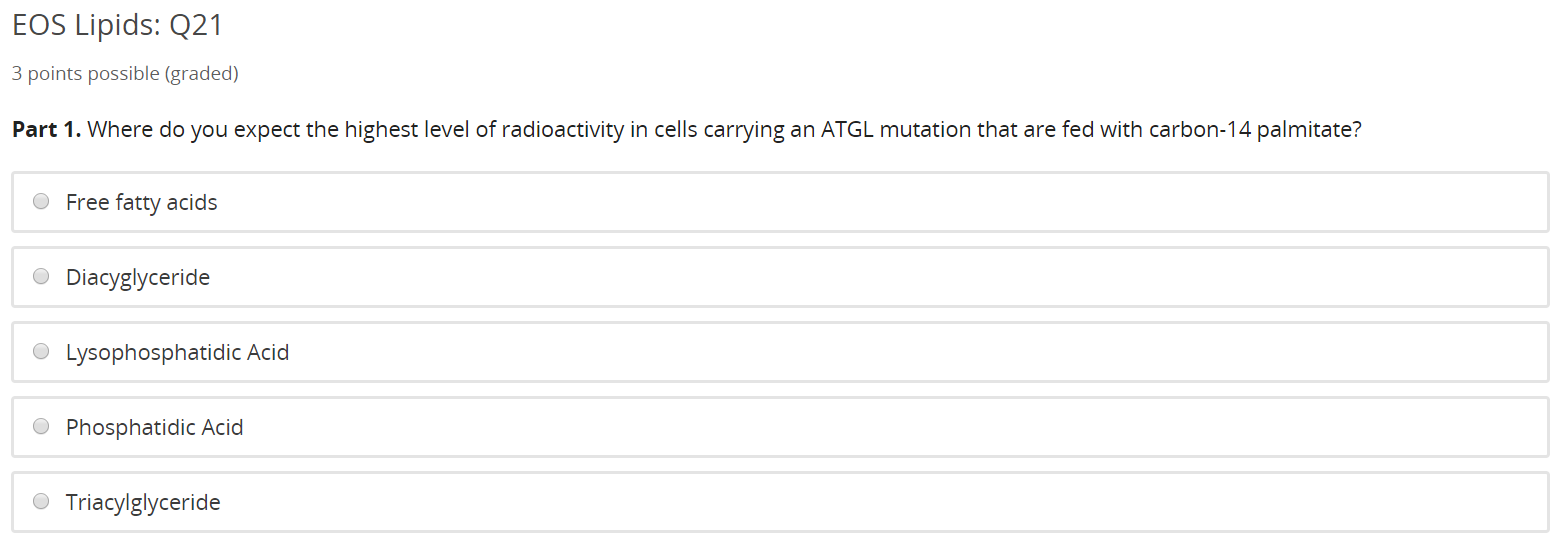
Triacylglyceride - because AGTL is not functional to turn Triacylglyceride to diacylglyceride.


Triacylglyceride - because ABHD5 cannot activate AGTL to turn Triacylglyceride to diacylglyceride.


I have a hard time to remember this one - I googled, the answer is:

Lysophosphatidic Acid - because AGPAT turns Lysophosphatidic Acid to Phosphatidic Acid.


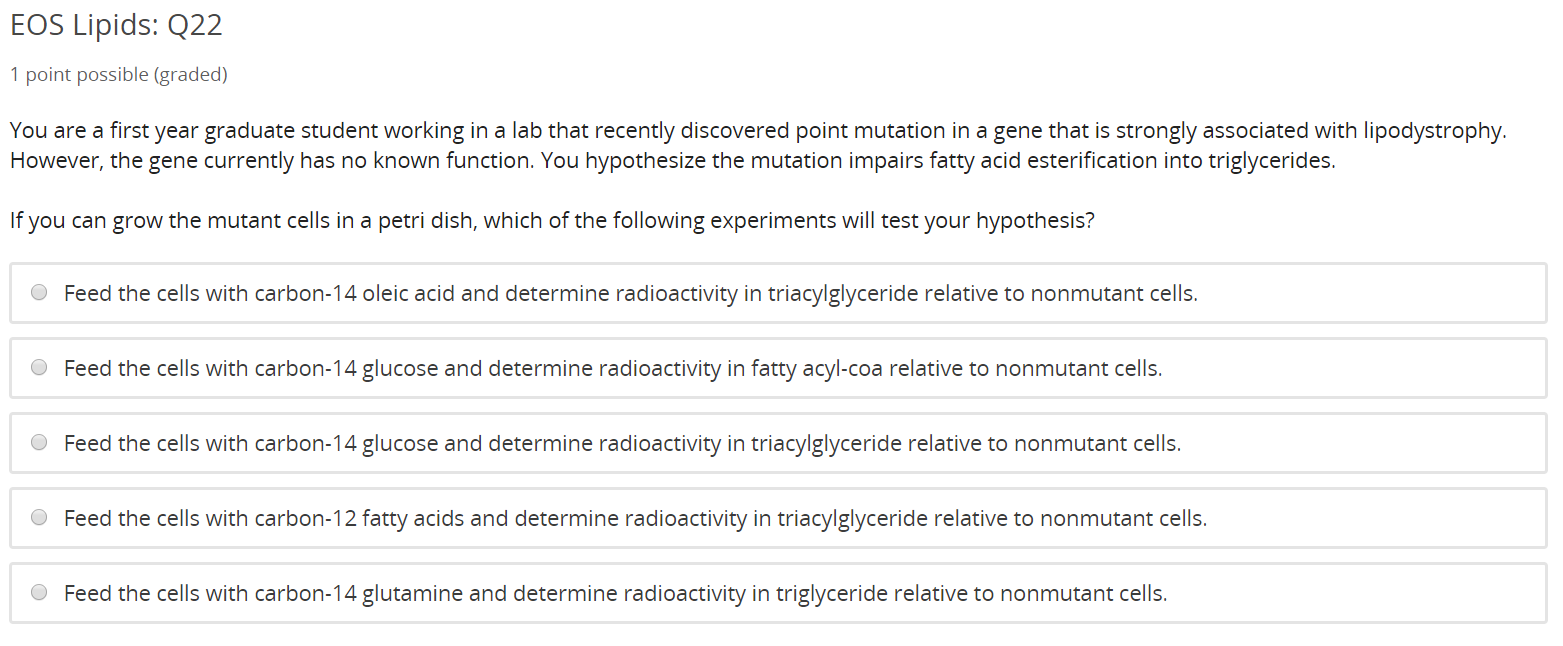
Oleic acid is simply a fatty acid with 18 carbons, therefore the answer is:

Feed the cells with carbon-14 oleic acid and determine radioactivity in triacylglyceride relative to nonmutant cells. correct


The way to read this is that the left hand side is showing us there is a difference in these different material's polarity causing a drift in the dot. The control cell has turn all free fatty acid into triglyceride, but the mutant cell stopped at the diacylglyceride stage, which means it has problem turning diacylglyceride to triglyceride, that proves the hypothesis there is a problem with triglyceride synthesis, the answer is

My observed result matched the result predicted by my hypothesis. Therefore, the data support my hypothesis and suggest my hypothesis is correct.


As long as a wish to just click "a biochemistry college professor" or "a computer engineer who led a relatively sedentary lifestyle", the lack of physical activity has a hard time to explain why lipid is not going away in 50 years!

The only sensible option is that his body cannot get rid of lipid at all - the answer would be a patient suffering from a neutral lipid storage disease.

Introduction to Biochemistry - End of session 2.5 assessment - Part 2


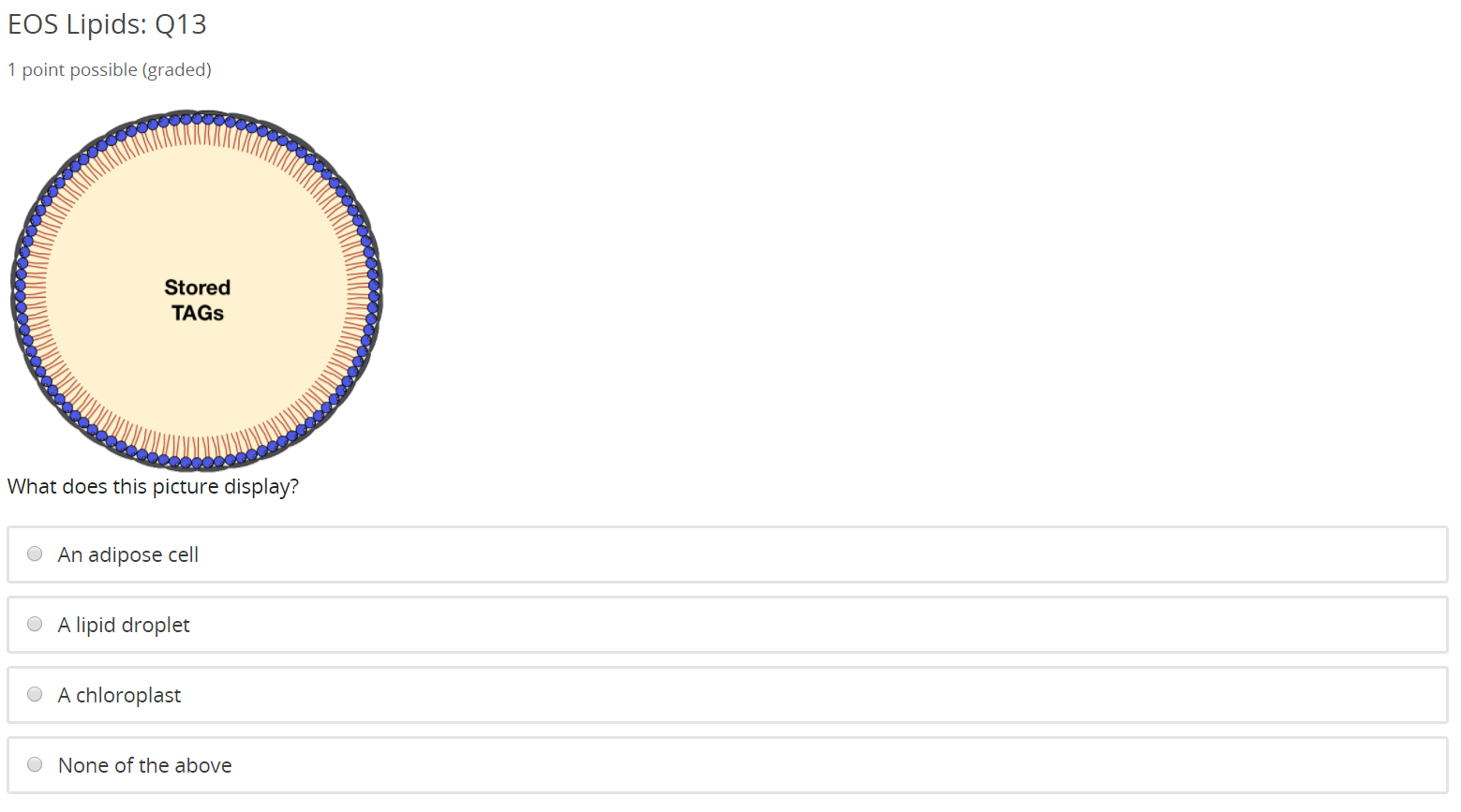
A lipid droplet.


It is a mutation in a gene - therefore it is not acquired not HIV related, it is familial partial lipodystrophy.


I thought for a healthy cycle we need it to live and then die, so I chose the first one, but no, the answer is development, differentiation and survival.


If we have a genetic mutation leading to constitutive inactivation of ATGL, the lipid droplet will never be able to go through lipolysis, so lipid droplet stays.

If we have a mismatch between caloric intake and energy expenditure, lipid droplet will not be consumed fast enough and stays.

That's the two reasons why we have ectopic fat deposition.


All options involves genetic mutation in the X gene is wrong because it is mutating one gene only. Antiretroviral treatment is not a genetic mutation, so it is wrong as well. The option "Obesity due to mutations in a group of non-allelic genes" is the only correct choice.


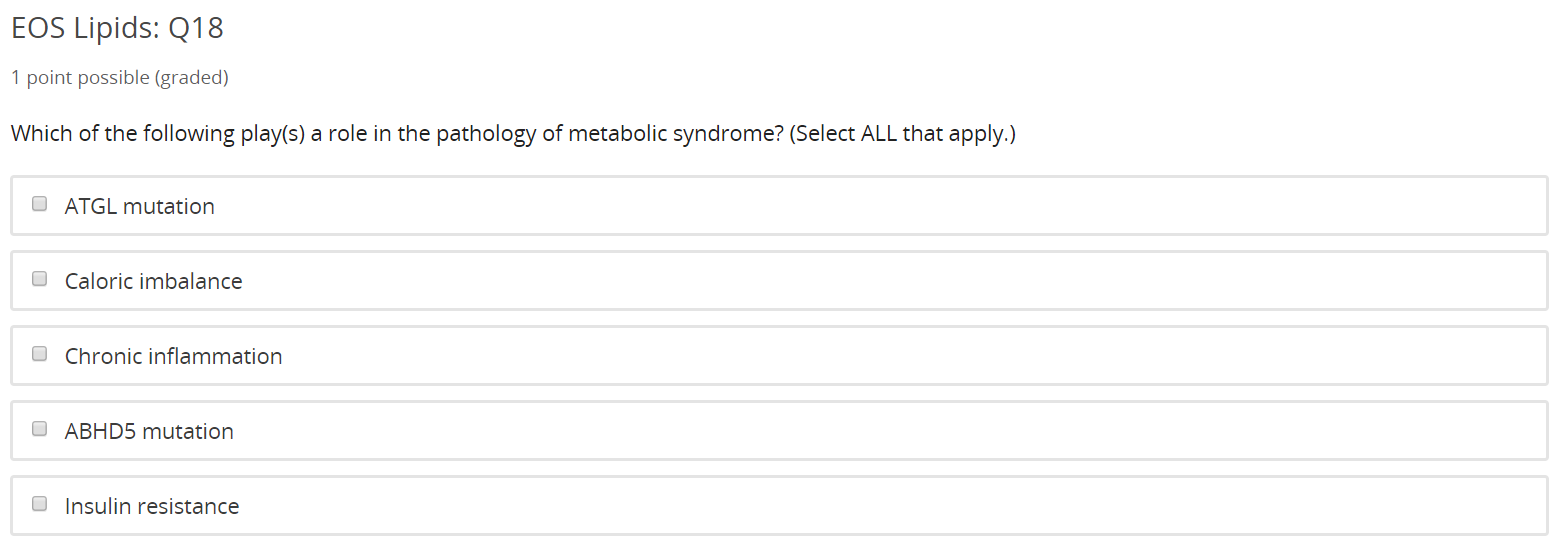
Caloric imbalance and insulin resistance is obvious. Not sure about the chronic inflammation part at first, but it is also a correct choice. The gene mutation choices are wrong.


The guy is obviously accumulating fat. It is not a problem in triglyceride synthesis, nor it is lipodystrophy. While I guess junk food is a possible reason, you don't usually have muscle weakness.

It is likely to be an acquired metabolic syndrome, at least that's what I thought.

The correct answer is:

You suspect the patient carries a mutation in a gene regulating lipolysis and recommends a genetic test to confirm.

I would wonder, why a genetic mutation related problem shows up when the man is already 42 years old, not sure why ... there must be some environmental trigger.

Introduction to Biochemistry - End of session 2.5 assessment - Part 1


Molecule 1 is sphingosine - notice the amine group. It is a backbone molecule just like glycerol is.
Molecule 2 is a saturated fatty acid - it has a carbonxyl group and a saturated tail.
Molecule 3 is glyercol
Molecule 4 is an unsaturated fatty acid
Molecule 5 is cholesterol, with these four rings.
Molecule 6 is triacylglycerol.


Triacylglceryol is efficient energy storage, so option 1 is wrong.

While the hydrophobic repulsion of Triacylglceryol is there, that does not explain its energy density, so option 2 is wrong, same thing with option 4.

The answer is option 3, the hydration of glycogen reduces its energy density relative to triacylglycerol.


The numbering is weird, it make much more sense to name the molecules inside out.

It starts with triacylglycerol (8).
When activated, ATGL (7) can start the first lipolysis process.
That generate diacylglycerol (5)
Which is then processed by the phosphorylated HSL (6) to continue the lipolysis.
Monoacylglycerol (4) is generated in the process.
It is then processed by MGL (3) to perform the last stage of lipolysis
The fatty acid (2) that is broken down in the triacylglycerol are carried by chaperone to the blood stream because they are hydrophobic, raw exposure of fatty acid in blood stream can be toxic.
Last but not least, the glycerol (1) is also transported through the blood stream, it doesn't need a chaperone.


The answer is 4 - hormone concentration in the blood communicate the energy needs of the body to adipocytes.

After fatty meal, the blood stream has more fat than usual, there is no reason for the body to mobilize stored fats, the opposite happens. Insulin is secreted and lipogenesis occur, fats get into adipocytes. So option 1 is wrong.

Hormone circulates in blood, they are usually hydrophilic (except from steroid hormone that needs a protein carrier), and they do not bind to fatty acid directly - put it the otherway, lipolysis haven't occurred yet, where are the fatty acid to bind to? They are deep inside the lipid droplet. So option 2 is wrong.

Option 3 is almost correct, during prolonged exercise, the body experience physiological stress, the hormone epinephrine (adrenaline) is secreted by the adrenal cortex under physiological stress. The beta adrenergic receptor on the adipocyte surface will be activated to trigger the lipolysis process. This is to mobilize the energy to handle the stress.

But notice it is the adipocyte surface, not the lipid droplet surface. So option 3 is wrong, we are almost there.

Option 4 is correct, hormone concentration in blood stream is the body's way to communicate the stress to adipocyte, so that it starts to mobilize the energy.

It is nice to correlate my knowledge in human physiology with my study in biochemistry.


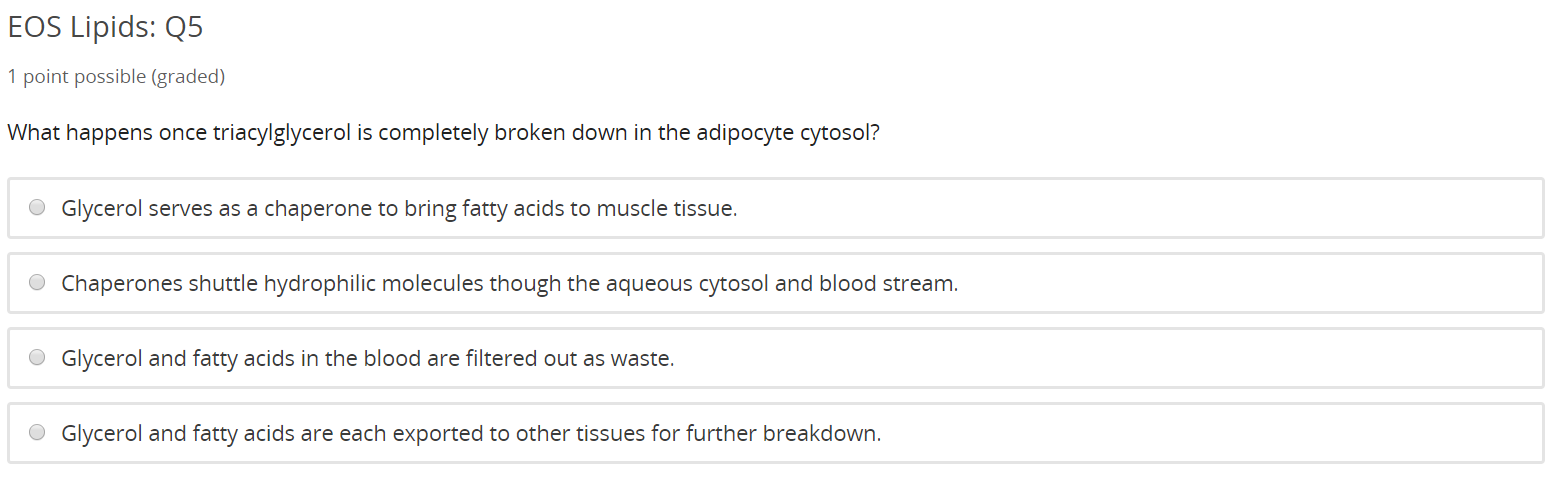
Glycerol is not the chaperone, so option 1 is wrong.
Chaperone shuttle hydrophobic molecules through the aqueous cytosol and blood stream, not hydrophilic, so option 2 is wrong.
Glycerol and fatty acid are useful, they are not waste, so option 3 is wrong.
The correct answer is option 4 - they are exported to liver and muscle for energy usage. It is broken down to use the energy stored in the bonds.


The outer leaflet has more cylindrical shape lipid while the inner leaflet has more conical shape leaflet, so the answer is

Sphingomyelin is most likely enriched in the outer leaflet, while
Phosphatidylethanolamine is most likely enriched in the inner leaflet.


This arrangement look so nice, it is regular packing and in paracrystaline state. This is rigid.
Adding cholesterol to it will be make it more fluid because it will no longer be so nicely packed.


This is simple, just reading graph, it is lipid 1 and lipid 2.


Conical shape things are in inner leaflet, so it is lipid 3 and lipid 4 that is conical shape.

Lipid 1 need to move from inner to outer. Floppase is needed to move lipid from inner to outer, so the answer is floppase.


I have got this wrong - I was tricked by myself about permeability by being able to let's thing in. Of course, factor that block things out are just as important - arguably more important than letting things in.

The key factor of blocking things out is the hydrophobicity. Here is the correct option:

The hydrophobic core of the lipid layer.

The key factor of lettings things in is the integral proteins. Here is the correct option:

The integral membrane proteins that allow molecule to cross.


This is simple, just reading graph, 12% is too low, low body fat is lipodystrophy.


The fill in the blanks problem is completed in the image above.

The idea is simple - lipogenesis create fat, so the lipid droplet grow, and the opposite is lipolysis. When fed, insulin store energy. So there is only one option left for the last one.


An easy one - mutation 2 causes slower growth of weight with high fat diet, the only reason is that the rat body doesn't store the intake fat, that is lipodystrophy.

Saturday, July 22, 2017

Introduction to Biochemistry - Quiz 2.5.7


In a healthy individual, fat is stored in a thin layer under the skin and around internal organs, that serves the purpose of insulation and padding.


Adipocytes contain one very large lipid droplet.


The excess fat is stored by increasing both adipocytes size and cell numbers.


Cachexia and Lipodystrophy are lack of lipid droplets, they cannot be correct because ectopic deposition is the abnormally large amount of lipid droplets.

The correct answer are the remaining two:

Metabolic syndrome resulting from caloric imbalance, and
Neutral lipid storage disease, myopathy subtype.


They are both diseases from a unique genetic mutation and Ichthyosis results from an unknown ATGL-independent function of ABHD5 that affects the skin’s lipid matrix.


It originates from dietary intake of fat, carbohydrates and proteins.