online advertising

Saturday, July 22, 2017

Introduction to Biochemistry - Quiz 2.5.6


12% is too few lipid droplets.


lipodystrophy and cachexia.

I think it is technically wrong reversed, I think it should be the opposite, lipodystrophy and cachexia leads to too few lipid droplets.


None of the other options make any sense, the only plausible choice is proper development, differentiation and survival.


Lipodystrophy is the loss of failure to develop adequate amounts of adipose tissue for energy storage.


This is from my memory in the lecture, it is mutation in the AGPAT.


This is also from my memory in the lecture, it is AKT2 and nuclear receptor PPARy.

Introduction to Biochemistry - Quiz 2.5.5


It is the fluorescently-labeled lipids.


At $ t = 0 $, the laser has bleached the lipid dye at this spot.

At $ t = 100 $, the lateral diffusion of the bleached and fluorescent lipids caused the dark spot to be mixed in.


Membrane protein serves their functions, so depending of the function of the cell or organelle, the percent mass of lipid versus protein will vary.


Red blood cell travels around the body, it is easy to imagine it need to perform many different functions, and therefore it has a lot of different proteins on its membrane. Photoreceptor, however, serve one purpose, to sense light, so it is reasonable to predict there is fewer types of protein on it.

Here is the answer.

The protein composition of a membrane reflects its function.

For example, while red blood cells and photoreceptors both have a high density of protein in their plasma membrane, red blood cells have a greater variety of protein while photoreceptor cells have essentially one type of protein in their membranes.


Basically integral protein can go through the membrane while peripheral protein are on one side, either outside or inside, so it is not hard to figure out:

Integral membrane protein must have hydrophobic coils that pass through the core of the lipid bilayer.
Peripheral membrane protein can be covalently linked to a lipid that is inserted in the lipid bilayer
Integral membrane protein can transduce an extracellular signal across the lipid bilayer.
Both membrane protein can serve functions on the intracellular and extracellular surfaces of the lipid bilayer.

The last one is tricky, I was tricked.


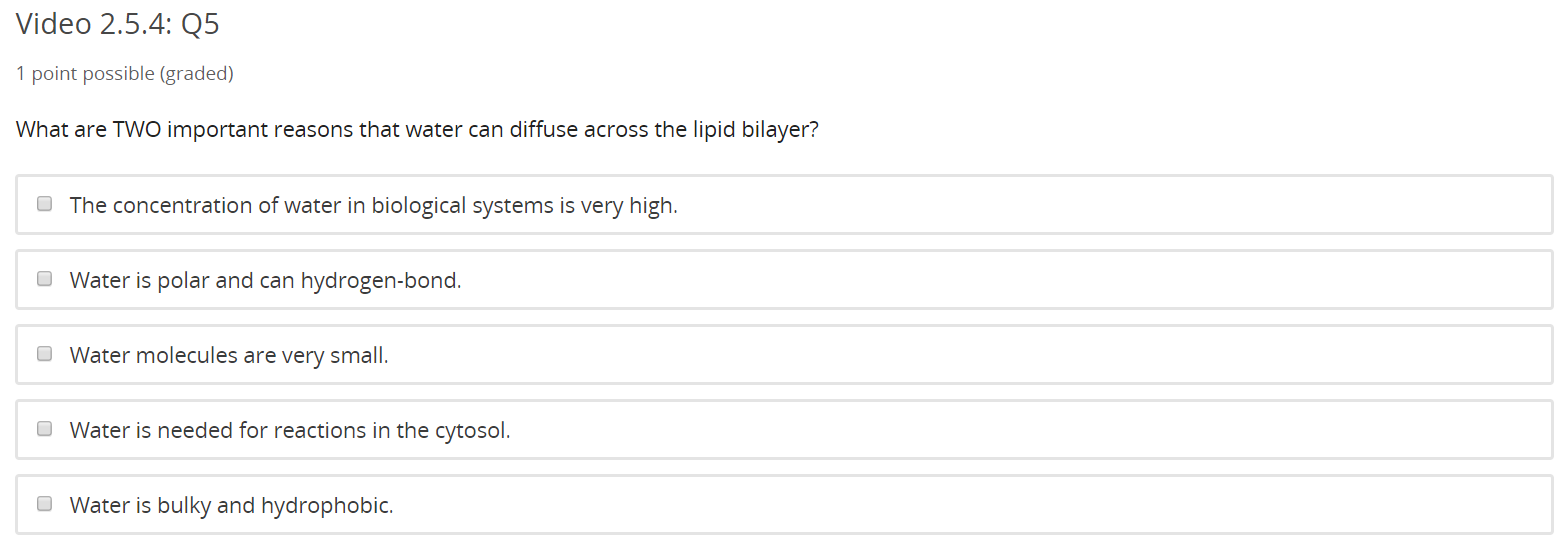
The first one is correct, water is very concentrated in the body - and the high concentration make a high concentration gradient if diffusion is blocked.

Many molecule are polar and can hydrogen bond, even a whole protein molecule can, this is wrong, being polar and can hydrogen bond alone cannot lead to diffusion.

Water molecule is small, and small molecule can easily go around barrier, this is correct.

While it is true that water is needed in the cytosol (for example, for protein folding), this is not a reason, so this is wrong.

Water is not hydrophobic and it is not bulky at all, so this is wrong.


The concentration gradient for these ions are crucial for neural signalling, they are maintained through pumps. These pumps are integral membrane proteins, so the answer is.

The ions require integral membrane proteins to cross.

Thursday, July 20, 2017

Introduction to Biochemistry - Quiz 2.5.4


Of the phospholipid shown above, those with a cylindrical shape are more likely to be found in the outer leaflet of the membrance, while lipid with a conical shape are more likely to be found in the inner leaflet.


Scrambase moves lipids down their concentration gradient, in either direction.
Floppase moves lipids against their concentration gradient, from inner to outer membrane.
Flippase moves lipids against their concentration gradient, from outer to inner membrane.
Scrambase actively promotes membrane compositional symmetry.


In the endoplasmic reticulum.


Sphingomeylin is synthezised in the lumen of the golgi apparatus and is transported to the plasma membrane by vesicles Sphingomeylin will first be incorporated into the outer leaflet of the plasma membrane.

This is because the inside of the vesicle contains the material that the cell wants to secret, so that will face outside after the vesicle merge with the plasma membrane.

Introduction to Biochemistry - Quiz 2.5.3


Lipid is hydrophobic while cytosol is hydrophilic, therefore we need a monolayer of phospholipids so that the hydrophilic heads interact with the cytosol and the hydrophobic tails interact with the triacylglycerols.

On the surface of the droplet, we have a network of perillipin, these proteins are useful for recruiting lipases.


As explained above, phospholipids are excellent for storing triacylglycerol because their hydrophilic head face the aqeuous environment, while their hydrophobic tail face the densely packed triacylglycerol.


The first and second lipase needs to be recruited to the lipid droplet to be active.


MGL (i.e. the 3rd lipase) is constitutively active in the cytosol.
ATGL (i.e. the 1st lipase) is recruited to the lipid droplet based on a binding partner in the perilipin network.
HSL (i.e. the 2nd lipase) is phosphorylated by PKA to facilitate recruitment to the lipid droplet.


Adrenaline is the right signal, but it does not degrade lipases.
Hormone bind to the plasma membrane G protein coupled beta adrenergic receptor, not on the surface of the lipid droplet.
The surface of lipid droplet is phospholipid, not sphingolipid.

The correct answers are:

Catecholamines triggers a signaling cascade that activates a key kinase (PKA), and
The perilipin network rearrange to promote recruitment of lipases


This is a fill in the blank problem, the blanks are already filled in the question above.

Sunday, July 16, 2017

Introduction to Biochemistry - Quiz 2.5.2


Triacylglycerol is mainly used for storing energy for the long term.


The hydrophobic properties of triacylglycerol allow for dense packing of carbons.
The carbons of triacylglycerol are in a highly reduced form.
Meanwhile, the carbons of glycogen are in a partially oxidized form.

I was a little confused about the reduction of carbon in triacylglycerol, in both an alkane or a carbon dioxide, carbon still officially own 6 electrons, and then I looked it up online and it is not the actual charge that matters, it is the oxidation state.


Gram for gram, triacylglycerol has higher energy density as compared to glycogen; however, glycogen is broken down more rapidly.

Introduction to Biochemistry - Quiz 2.5.1

We are starting a whole new topic on lipids now.


Lipids encloses aqueous cytosol of an animal cell in a bilayer (not a monolayer) - the monolayer is used to enclose triacylglycerols in adipocytes.

Lipids are not polymers.

Sphingolipid have peptide bonds, but most other don't.

Therefore the correct answer is:

Lipids all have a large hydrophobic region.


Sphingosine has a amine group, not a nitrogen group. I don't know if the term "nitrogen group" exists or not, the closest I can think of is cyanide, which is highly toxic.

The molecule drawn has a double bond in it, so it is not saturated.

Lipid formed with sphingosine, such as sphingomyelin, are often structural lipid, not storage lipid.

Therefore the correct answers are:

Sphingosine already contains one hydrocarbon 'tail', and
Sphingosine serves as a backbond, like glycerol.


Each of the 3 hydroxyl group of glycerol and the carboxylic acid group of the fatty acid reacts to form ester bonds, that's how triacylglycerols are formed. Therefore, the correct answer is:

... a fatty acid is esterified to each hydroxyl group of glycerol.


The key intermolecular interaction force between lipid molecules is Van der Waal's force. Molecule A, a saturated lipid is more regular and can be closely packed, therefore it will have more Van der Waal's force. On the other hand, molecule B will have less and therefore easier to boil, and theerfore it is more likely to be liquid at room temperature.

Thursday, July 13, 2017

Introduction to Biochemistry - End of session 2.3, 2.4 assessment - Part 4

I am really happy that I get this part all correct!


$ T_m $ is the temperature when 50% of the protein denatures. Therefore the answer is C.


The individual has antigen A and B expressed on the cell, so he don't have anti-body A or B, he can receive all blood types.


The higher the catalytic activity, the more elimination of hydrogen-halide is going on. Hydrogen halide will disassociate in aqueous solution and form hydrogen ion, so the pH will decrease, the less red will result.

Therefore the answer is A - it has least red and highest catalytic activity.


A is the best because it reacts with the mediator more than with oxygen. B react with mediator well as well, but it also react well with oxygen, the net difference is not as high as A does.


IMAGE NEEDS ALT TEXT? LOL...!

This problem is hard, I think more a long while - you want the $ k_m $ to me low because then the enzyme has high affinity, and you want $ k_{cat} $ to be high, because then the reaction is fast.

The one with low $ k_m $ and high $ k_{cat} $ for NADH is C.


The one with low $ k_m $ and high $ k_{cat} $ for NADPH is A. arguably, the WT works the best, but that's not an option.


This one is easy, you want to decrease red signal for lower pH just like problem 39 and you want decreased NADH level if you want it to react.