online advertising

Thursday, July 13, 2017

Introduction to Biochemistry - End of session 2.3, 2.4 assessment - Part 3


The answer is factor XIII, this factor allows fibrin to form stable mesh.


Factor X will activate prothrombin to start the blood coagulation cascade, so this patient would have blood clot even if there is no wound, therefore the answer is thrombosis.


When we have a wound, the collagen fibers are exposed to the plasma, the circulatng von Willebrand factor binds to the collagen, shear force unfold the vWF and then the unfolded vWF binds to the platelet receptor.

Therefore the answers are

Clot initiation is triggered by tissue damage exposing collagen fibers that are normally "invisible" to the plasma.
Shear force produced by the tissue damage cause vWF to unfold and interact with collagen fibers.
vWF binds platelet receptors and activate them.

Note that platelet is also recruited by fibrinogen during the blood clot initiation, not by fibrin. The two heads of a fibrinogen molecule can attach to two activated platelets.


Once the blood clot is initiated, the clot need to grow, this is done by secretion of ADP and thromboxane A2 by activated platelet. Therefore the answer is:

Extension is largely mediated by factors secreted by activated platelets at cut site, and
ADP and thromboxane A2 (TxA2) are agonist that recruits and activate additional platelets during extension phase.


Prothrombin and Protein C are zymogens. They are always present and therefore they are not suitable targets.


I only know about Bacteriophage screen, so that must be the answer :p
Looking up the other screens on Google yield some interesting read, I will read them later.


The heavy water option is interesting and I did some lookup on Google. People did patent using heavy water as MRI contrasting agent, but it is not a great candidate because heavy hydrogen has stronger hydrogen bond properties, and often cause disruption in normal biochemical reactions.

Pure heavy metal does give strong magnetic signal - but it is toxic.

We do not want radioactivity - so radioactive glocuse is not great.

We are detecting blood clot, so it better stay in the plasma, fatty acid is hydrophobic and will likely leave the blood vessel, not a great candidate either.

Therefore the answer is a heavy metal enclosed in a chelator to maximize contrast and prevent toxicity.


To do ISM, we need to know the molecule fairly well to have good candidate for target sites. That gives us enzyme C. Enzyme D requires multiple steps assay and is less than ideal.


It is simply $ 4 \times 3 \times 2 = 24 $


Note that the question is asking for the third round, the next round will be on library A, and the next next round (i.e. the third round) will be on library B.


The best order is B > A > D > C.


In this problem - the mutant are all fairly similar. The aspartate to lysine change is a relatively bigger one, so I chose this one, and it is correct.

Wednesday, July 12, 2017

Introduction to Biochemistry - End of session 2.3, 2.4 assessment - Part 2


This is a fill-in-the-blank problem. Frankly this is just a memorization exercise. I remember the C-peptide is in the middle and the remaining two chains were linked by the disulphide bonds. What I don't remember is which part is A and which part is B, so I just tried, failed once, thanksfully I have another try so I make it :)


I was confused with the "Binding Capacity" phrase, not sure what that means without a context. For this problem in particular, it seems to be irrelevant. The way I interpreted that is that in the wild type, the Proinsulin level is low, persumably we are measuring the concentration at location where the proinsulin is expected to be cleaved (e.g. in blood plasma), so the mutant has problem to be cleaved. So a reasonable answer would be "Within one of the splicing sites", and that's correct.


Given the last problem is correct, the only sensible solution for this one is "Within the A chain or the B chain". Now the "Binding capacity" make sense, it means the ability of the hormone to bind its receptor. If the A-chain or B-chain is not changed in the previous problem, it probably is still capable to bind the receptor.


I respectfully disagree the answer given on EDX for this one.

The mutation is occurring on the splicing site - therefore, we should be in a situation similar to problem 14, with elevated proinsulin level. Instead of that, the given correct answer is lowering binding affinity for the insulin receptor, that's just sound strange to me.


It is $ \alpha-$ chymotrypsin - chymotrypsinogen is the zymogen and trypsin is the agent used for the cleaving.


The first few amino acid starting from the N-terminal is the signal peptide, they are used to direct the protein to different organelles. Therefore the answer is

They most likely are targeted to different cellular locations.


If chymotrypsin were translated into active form inside the pancreas, it would start digesting the protein inside the pancreas. Therefore the answer is

Pancreatitis (breakdown of pancreas cells)


The C peptide is the short peptide chain that connects insulin's A chain and B chain.


This is yet another fill-in-the-blank problem, the question above has the answer is it already.


Thrombin cleaves fibrinogen.


Factor VII and tissue factors are the extrinsic pathway.
Factor XI is the intrinsic pathway.


Both AntiThrombin (AT) and Thrombomodulin inhibit thrombin.

Tuesday, July 11, 2017

Introduction to Biochemistry - End of session 2.3, 2.4 assessment - Part 1


  1. Free Energy
  2. Transition state
  3. $ \delta G $ uncatalyzed
  4. $ \delta G $ catalyzed
  5. Substrate
  6. ES
  7. EP
  8. Product
Technically, I think the answer for 3 and 4 should be the activation energy, not the $ \delta G $, but those are the only given choice, so that's it.


I failed this one. I got this right:

They correctly position the substrate in the active site

But I missed this one

They decrease the entropy of the system.

With bonds, there is reduced randomness, I get that, but how can that contribute the catalysis, I still don't know.


I failed this one too, here is the correct answer:

In Emil Fisher's 'lock-and-key' model of enzyme specificity, the enzyme binds tightly and precisely to the substrate. (That I am correct)

In the modern 'induced fit' model, the enzyme binds weakly to the substrate and then change conformation and binds tightly to the transition state.

My concept was wrong, the enzyme does not binds weakly to the transition state and then change conformation and binds tightly to the product. I was dumb, if it binds tightly to the product, how does it release it?

I feel fairly frustrated at this point, but things are changing ... I got all the rest correct!


If enzyme binds to S1 first, the S1 would probably react with something else. Therefore, the catalysis is more efficient if the enzyme binds S2 first, then change conformation to bind S1, that gives a better chance for S1 to react with S2 since it will be right there.


The answers are:

To measure forward velocity of the reaction with a negligible contribution from the reverse reaction, and
to measure the velocity of the reaction with a known substrate concentration.

Option 3 is bogus, there is no uncatalyzed reaction going on.
Option 4 is also wrong, enzyme we not destroyed.


This is just math. It $ K_m $ is small, then $ [ES] $ is large, the enzyme substrate complex is preferred to the enzyme and the substrate alone, therefore the enzyme has high affinity to the substrate. The reverse it obvious, if $ K_m $ is large, $ [ES] $ is small, the enzyme substrate complex is not preferred to the enzyme and the substrate alone, so the enzyme has a low affinity for its substrate.


This is also just math, if $ [S] $ is way less than $ K_m $, then the denominator is essentially constant even when $ [S] $ change, therefore the answer is

The $ [S] $ term in the denominator is negligible compared to $ K_m $. There is a linear relationship between substrate concentration and velocity.


The question capture above is already filled with answer, it is probably easiest for me to just capture the answer, the original question is just a few in the blank of the derivation.


Answer


This is a graph of uncompetitive inhibitor.


A noncompetitive inhibitor decrease $ V_{max} $ while keeping the $ k_m $ constant, so the first three options are all wrong. It done so by binding both to the enzyme and the enzyme-substrate complex.


Notice $ v_{max} $ is unchanged, this is a competitive inhibitor.

Sunday, July 9, 2017

Introduction to Biochemistry - Quiz 2.4.6


Blood type O means the blood cells do NOT express antigen A and antigen B, which means the individual will be antibody A and antibody B, he would die if we transfuse the individual with blood type A and blood type B because the antibody A and B in that individual will attack the transfused blood.

Therefore the answer is Blood Type O.


Halohydrin are alcohol with a hydrogen replaced with a halogen (the hydroxy group and the halogen are adjacent). The halohydrin dehydrogenase will convert that into an epoxide, getting rid of the halogen and a hydrogen, they will form hydrohalic acid and therefore free proton in the aqueous solution. Therefore, the answer is:

When the enzyme activity of halohydrin dehydrogenase increase, more protons ($ H^+ $) are released in the catalyzed reaction.


More protons means lower pH means more yellow, therefore the answer is Mutant D.


There is no way I can answer this question from the question alone. It requires context from the lecture video. The goal of the ISM is to reduce oxygen activity and make sure the electrons are get from the electrodes when one want to use the engineered enzyme to measure blood glucose level , therefore the answer is Mutant B because that mutant leads to reduced oxygen activity.


We want the enzyme to use NADH, therefore, we are looking for increased NADH affinity and increased catalytic rate.


I failed this one and I still do not understand, the $ K_m $ for NADH will obviously increase because the equilbrium would shift towards forming the enzyme substrate complex, what I don't understand is why will have lower $ K_{cat} $, doesn't that means the reaction shift towards not creating the product?


This is basically the same as question 3 above, increased activity, decreased pH, increase in yellow signal.

Introduction to Biochemistry - Quiz 2.4.5


I failed this one with two attempts - the answer is A.

Here are my attempts:

I initially chose C because it is fairly well studied which means we can "direct" the evolution, and the fluorescence based assay make high throughput screen easy. However, I missed the keyword "multi-step". Multi-step is not great.

Then I chose D, presumably single step is better, however, radioactivity make high throughput screen hard as well.

The official correct answer is "A" - we don't know the structure nor the catalytic sites, but it is easy to screen, it is up to the evolution to help us to identify things, I guess that make directed evolution different from semi-rational approach.


It is simply $ 4 \times 4 \times 2 = 32 $.


ISM is a greedy approach, it myopically choose the current best to move on, so it is library B.


This is a trick question - the correct answer is "Not enough information". There is no way we can identify catalytic sites based on only the secondary structure, the real 3D structure is needed.


All the mutants are close relatives except mutant D, glycine to phenylalanine is a big change.

Introduction to Biochemistry - Quiz 2.4.4

I got all the answers correct this time all on the first attempt!


Notice $ V_{max} $ doesn't change - this is a characteristic for competitive inhibition. $ V_{max} $ does not change because the inhibition is done by competing with enzyme with the substrate, once the substrate concentration increase the inhibition will eventually give way to the substrate and therefore $ V_{max} $ stay constant.


This is Noncompetitive - it is confusing because we have uncompetitive and noncompetitive. Uncompetitive means the inhibitor does not compete with the substrate for the enzyme, instead, it binds to the substrate enzyme complex to inhibit the reaction by not allowing the enzyme substrate complex to turn into product. In that case the lines would be parallel. Noncompetitive is confusing because it is actually competiting, but it is competing and also blocking the enzyme substrate complex to turn into product, to the point that $ k_m $ is identical with the enzyme not inhibited.

Strange name - I have to say, a non-competitive inhibition is actually using the competitive mechanism.


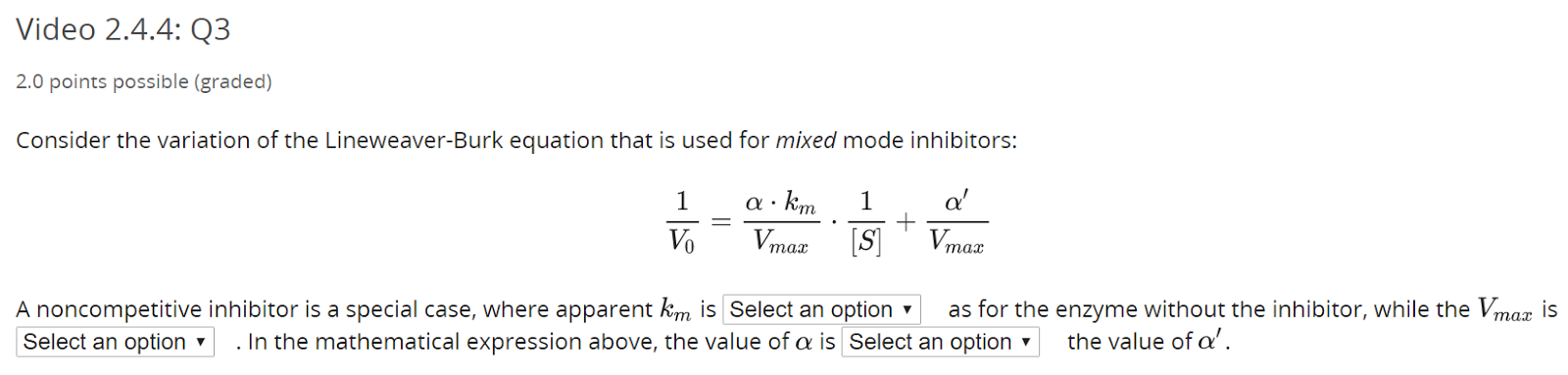
A noncompetitive inhibitor is a special case, where apparent $ k_m $ is the same as for the enzyme without the inhibitor, while the $ V_{max} is decreased. In the mathematical expression above, the value of $ \alpha $ is equal to the value of $ \alpha '$


Remember for competitive inhibitor the line have the same $ y $ intercept and bigger slope, therefore $ \frac{1}{k_m} $ is smaller, therefore $ k_m $ is larger.

It increase the apparent $ k_m $ of the enzyme
It binds the enzyme complex in its active site.


This is similar to the above, because the line is parallel, uncompetitive inhibitor decreases $ k_m $ and $ v_{max} $

It decreases the apparent $ k_m $ of the enzyme.
It binds the enzyme-substrate complex.


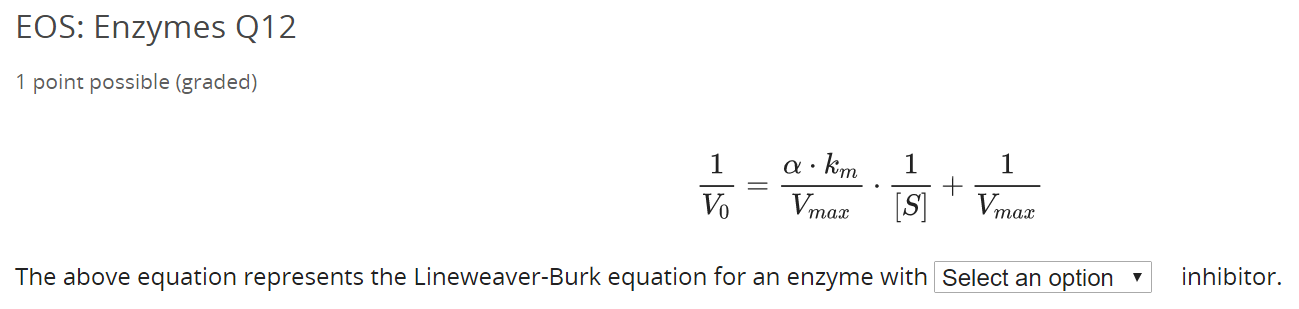
The above equation represents the Lineweaver-Burk equation for an enzyme with a mixed inhibitor.

This is so because we have two alphas.


Note that the slope of the equation does not change, it is the parallel line case.

The above equation represents the Lineweaver-Burk equation for an enzyme with an uncompetitive inhibitor.